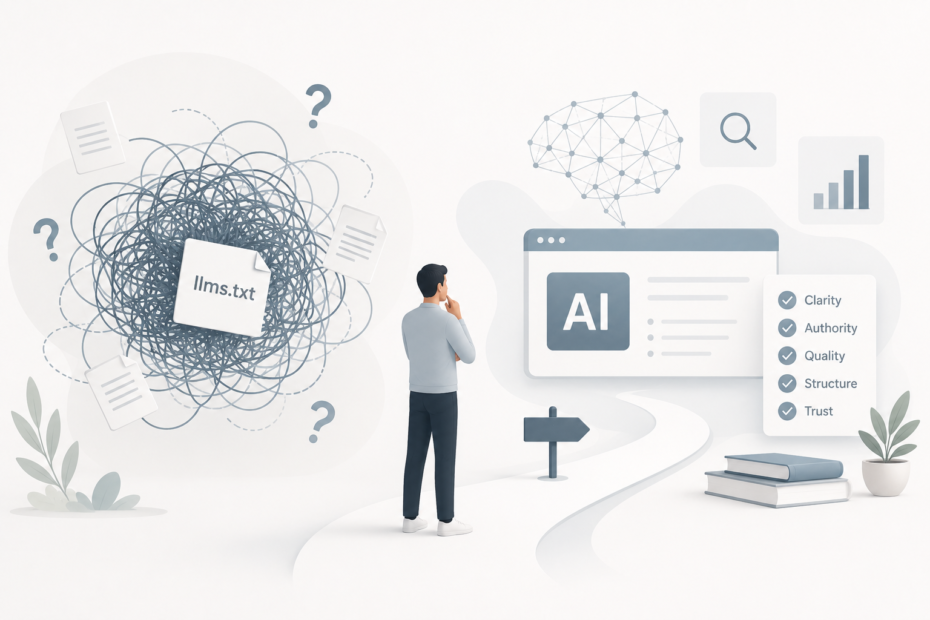
The Great llms.txt Confusion of 2026 refers to the widespread belief that implementing an llms.txt file could improve AI visibility, increase citations in platforms such as ChatGPT and Perplexity, or help websites rank better in AI-powered search experiences. While the file was created to help AI systems discover important resources more efficiently, many marketers and website owners began treating it as a direct ranking signal for AI search.
This misunderstanding grew rapidly throughout 2026 as AI search became more mainstream. Agencies started offering llms.txt implementation services, SEO blogs published tutorials, and businesses rushed to add the file without fully understanding its purpose. The result was a gap between expectation and reality. Although llms.txt may help certain AI systems locate documentation and important content, there is currently no public evidence showing that simply adding the file leads to higher rankings, increased traffic, or guaranteed citations in major AI platforms.
Understanding how this confusion developed requires examining both the origins of llms.txt and the broader changes taking place in search and content discovery.
Why Everyone Suddenly Started Talking About llms.txt
To understand why llms.txt gained so much attention, it is important to understand what was happening across the search industry during 2025 and 2026.
For more than two decades, search engine optimization followed a relatively predictable model. Businesses created content, search engines crawled that content, rankings determined visibility, and users clicked through to websites. Although algorithms have evolved significantly over the years, the overall relationship between websites and search engines has remained largely unchanged.
The emergence of large language models disrupted that model.
Instead of reviewing multiple search results, users increasingly began asking questions directly to AI systems. Whether through ChatGPT, Gemini, Claude, Perplexity, or other AI assistants, people were becoming accustomed to receiving synthesized answers instead of traditional lists of links.
This shift immediately created uncertainty among website owners and marketers. If users were obtaining answers directly from AI systems, businesses needed to understand how those systems discovered information and selected sources. Questions that barely existed a few years earlier suddenly became critical:
- How do AI systems find website content?
- What signals influence AI citations?
- How can businesses increase visibility in AI-generated answers?
- Will traditional SEO still matter?
As the industry searched for answers, attention naturally turned toward new standards, protocols, and technologies that appeared relevant to AI discovery. One of those technologies was llms.txt.
The concept seemed straightforward. Website owners could create a dedicated file that directs AI systems to important content, making it easier for machines to find valuable resources. For organizations with extensive documentation, knowledge bases, API references, and technical content, the idea made sense.
Unfortunately, the concept’s simplicity also made it easy to misunderstand.
What Was llms.txt Originally Designed to Do?
One reason confusion emerged so quickly is that many discussions focused on potential outcomes rather than the intended purpose.
At its core, llms.txt was designed to act as a recommendation file. The goal was not to control AI behavior, improve rankings, or guarantee visibility. Instead, it was intended to provide a structured list of resources that AI systems might find useful when attempting to understand a website or answer questions about it.
A typical implementation might include:
- Product documentation
- API references
- Technical guides
- Knowledge base articles
- Research resources
- Support documentation
This approach is particularly useful for websites containing thousands of pages where important information may otherwise be difficult to discover.
For example, a software company with extensive API documentation may want AI coding assistants to access official documentation rather than relying on scattered third-party explanations. In that scenario, llms.txt functions as a curated roadmap that helps direct AI systems toward authoritative resources.
However, an important distinction is often lost in discussions about AI optimization.
Providing a recommendation is not the same thing as influencing visibility.
A restaurant can place a sign outside recommending a particular dish, but that recommendation does not force every customer to order it. Similarly, an llms.txt file can recommend resources to AI systems, but it cannot determine whether those resources will ultimately be retrieved, cited, or referenced.
This distinction lies at the heart of the confusion that followed.
Where the Confusion Started
The confusion surrounding llms.txt did not arise from the file itself being misleading. Instead, it emerged because the SEO industry was actively searching for new opportunities in a rapidly changing environment.
Historically, SEO professionals have become accustomed to identifying signals that influence visibility. When schema markup appeared, marketers explored its impact on search results. When Core Web Vitals emerged, businesses invested heavily in performance optimization. When mobile-first indexing arrived, websites adapted accordingly.
As AI search gained momentum, many professionals assumed there would be a similar set of optimization techniques that could improve AI visibility.
This expectation created fertile ground for misunderstanding.
Because llms.txt appeared around the same time that businesses were asking questions about AI discoverability, many people began connecting the two concepts. Articles started comparing llms.txt to robots.txt and sitemap.xml. While these comparisons helped explain the file at a basic level, they also created unintended assumptions.
Readers naturally concluded that if robots.txt influences crawler behavior and sitemap.xml helps search engines discover content, then llms.txt must influence AI visibility in a similar way.
That conclusion spread rapidly across blogs, social media discussions, webinars, and newsletters. Over time, the narrative shifted from “llms.txt helps AI systems locate important resources” to “llms.txt helps websites appear in AI results.”
Although the difference between those statements may appear subtle, it represents a fundamentally different claim.
One describes discoverability.
The other implies visibility.
That distinction is critical because discoverability alone does not guarantee visibility, citations, traffic, or rankings.
The Five Biggest Myths About llms.txt
As adoption increased throughout 2026, several misconceptions became particularly common.
Myth #1: llms.txt Improves Google Rankings
There is currently no evidence suggesting that llms.txt directly influences Google’s organic ranking systems. Traditional ranking signals such as content quality, backlinks, relevance, authority, and user experience remain significantly more important.
Myth #2: ChatGPT Uses llms.txt for Rankings
Even if AI systems can access llms.txt files, that does not mean they use them as ranking signals. The existence of a file and the influence of a file are two very different things.
Myth #3: Every Website Needs llms.txt
Many websites can implement llms.txt without any downside, but not every website receives equal value from it. A small local business website with a handful of pages may gain very little compared to a SaaS company managing thousands of documentation pages.
Myth #4: llms.txt Replaces Structured Data
Structured data and llms.txt serve different purposes. Schema markup helps machines understand content at a granular level, while llms.txt provides guidance toward important resources.
Myth #5: llms.txt Is the Future of AI SEO
The future of AI discoverability will likely involve multiple technologies, standards, and protocols working together. Treating llms.txt as the single solution to AI visibility oversimplifies a far more complex ecosystem.
Does llms.txt Actually Work?
The answer depends entirely on how you define the word “work.”
If the goal is to provide AI systems with a curated list of important resources, then llms.txt can absolutely serve a useful purpose. For websites containing extensive documentation, product guides, API references, support content, and technical resources, a structured recommendation file may help AI systems locate authoritative information more efficiently.
However, if the goal is to increase AI citations, improve visibility in ChatGPT, generate more traffic, or improve rankings in AI-powered search experiences, the answer becomes far less clear.
One of the biggest challenges in evaluating llms.txt is that many AI platforms operate as black boxes. Unlike traditional search engines, which provide extensive documentation about crawling, indexing, and ranking, AI systems often reveal relatively little about how information is discovered, selected, and presented.
As a result, many of the claims surrounding llms.txt remain difficult to verify.
What we can say with reasonable confidence is that there is currently no publicly available evidence showing that simply adding an llms.txt file results in measurable ranking improvements, increased AI citations, or greater visibility across major AI platforms.
That does not mean the file lacks value. It simply means its value is often overstated.
The reality is that AI systems evaluate information using numerous signals, including content quality, authority, entity understanding, citation patterns, structured data, retrieval mechanisms, and source trustworthiness. Within that much larger ecosystem, llms.txt appears to function more as a supporting resource than a primary visibility signal.
For businesses, this distinction is important because it helps establish realistic expectations. Implementing llms.txt may be worthwhile, but it should be viewed as one component of a broader AI visibility strategy rather than a standalone solution.
Reality vs Expectations
The easiest way to understand the confusion surrounding llms.txt is to compare common expectations with what the file actually does today.
| Expectation | Reality |
| llms.txt improves Google rankings | No evidence currently supports this claim |
| llms.txt guarantees AI citations | No evidence currently supports this claim |
| llms.txt helps AI systems locate important resources | Yes, this is its intended purpose |
| llms.txt replaces robots.txt | No, they serve completely different functions |
| llms.txt replaces schema markup | No, structured data remains important |
| llms.txt is useful for documentation-heavy websites | Often yes |
| Every website needs llms.txt | Not necessarily |
| llms.txt alone can improve AI visibility | Unlikely |
Looking at the table above reveals why so many businesses became confused. The practical value of the file is relatively modest compared to the dramatic expectations that often surrounded it.
Who Benefits Most From llms.txt?
One of the biggest mistakes made during 2026 was assuming that all websites would benefit equally from llms.txt. In reality, the value of the file depends heavily on the type of website being managed.
Organizations with large volumes of technical content are typically the strongest candidates for implementation.
SaaS Companies
Software companies often maintain extensive documentation covering product features, integrations, APIs, troubleshooting, and onboarding. Helping AI systems discover this information efficiently can improve the accuracy of AI-generated responses about the product.
API Providers
API providers are perhaps one of the clearest use cases for llms.txt. AI coding assistants frequently reference documentation when helping developers write code, troubleshoot issues, or integrate services.
Developer Platforms
Developer-focused platforms often contain thousands of documentation pages. Providing a curated guide to the most important resources can be beneficial for both humans and machines.
Research Organizations
Research institutions and knowledge-driven organizations may also benefit from helping AI systems locate authoritative reports, studies, and reference materials.
Large Knowledge Bases
Companies operating extensive support centers can use llms.txt to highlight critical resources that answer common user questions.
By contrast, a small local business website with ten service pages may experience little measurable benefit. A roofing company, dentist, plumber, or local restaurant typically gains more value from improving content quality, strengthening local SEO signals, and building brand authority than from investing significant time in llms.txt optimization.
This does not mean local businesses should avoid implementing the file. Rather, it means they should prioritize higher-impact activities first.
What Matters More Than llms.txt for AI Visibility?
One of the most useful lessons from the Great llms.txt Confusion of 2026 is that it forces businesses to ask a more important question:
What actually influences AI visibility?
Although no company outside the major AI providers knows every signal involved, several factors consistently appear more important than the presence of an llms.txt file.
Strong Entity Signals
AI systems work best when they clearly understand who you are, what you do, and how you relate to other entities.
Organizations should ensure that their website clearly communicates:
- Business name
- Products and services
- Authors and contributors
- Company background
- Industry expertise
- Geographic relevance
The easier it is for machines to understand your identity, the easier it becomes to associate your content with relevant topics.
High-Quality Content
Content remains the foundation of visibility.
Regardless of how advanced AI systems become, they still require reliable information sources. Businesses that publish original insights, research, case studies, tools, and genuinely useful content are more likely to earn citations than those relying on generic content.
Structured Data
Schema markup continues to play an important role in helping machines interpret information.
Organization, Person, Article, FAQ, Product, Service, and LocalBusiness schema all contribute to machine readability.
Brand Authority
Brands that are consistently mentioned across trusted websites tend to establish stronger credibility signals.
AI systems frequently rely on authority indicators when determining which sources deserve trust.
Technical Accessibility
Fast websites, logical site architecture, clean HTML, and accessible content all contribute to improved machine understanding.
Even the best content becomes difficult to utilize if systems struggle to access or interpret it.
When viewed collectively, these factors appear significantly more influential than whether a website has implemented llms.txt.
What Businesses Should Do Instead: A Practical Framework
Rather than viewing llms.txt as a magic solution, businesses should treat it as one small part of a broader AI visibility strategy.
A practical framework for 2026 looks something like this:
Step 1: Strengthen Your Entity Presence
Make it easy for both humans and machines to understand who you are, what you offer, and why you are credible.
Step 2: Publish Citation-Worthy Content
Create resources worth referencing. Original research, industry studies, calculators, tools, surveys, and unique insights tend to attract far more citations than generic articles.
Step 3: Implement Structured Data
Ensure your most important content includes relevant schema markup to improve machine readability.
Step 4: Improve Content Architecture
Use logical headings, clear navigation, internal linking, and topic clusters to help both users and AI systems navigate your website.
Step 5: Build Authority Beyond Your Website
Mentions, citations, reviews, partnerships, and industry recognition contribute to stronger trust signals.
Step 6: Monitor AI Visibility
Track how often your brand appears in AI Overviews, ChatGPT responses, Perplexity answers, and other AI-generated experiences.
Step 7: Implement llms.txt
Finally, add llms.txt as a supporting resource. It is low effort, carries little risk, and may help certain AI systems discover important content more efficiently.
The key is understanding where it belongs within the overall strategy. It should complement foundational efforts rather than replace them.
Looking Beyond llms.txt: WebMCP and the Future of AI Discovery
One reason the llms.txt discussion became so intense during 2026 is that the technology arrived at a time when the entire web ecosystem was trying to understand how AI systems would interact with websites in the future.
Historically, websites were built primarily for humans and secondarily for search engine crawlers. AI agents introduce a different challenge. Instead of simply reading information, future systems may need to interact with websites, retrieve structured data, complete tasks, compare information, and communicate with services in real time.
This is where newer concepts such as Model Context Protocol (MCP) and WebMCP have entered the conversation.
While llms.txt focuses on helping AI systems discover useful resources, MCP-related approaches focus on enabling structured interactions between AI systems and external sources. Rather than simply pointing an AI model toward documentation, these frameworks aim to create standardized ways for AI agents to access information and perform actions.
Although the long-term future remains uncertain, many experts believe AI discovery will eventually rely on a combination of technologies rather than a single file format. Structured data, APIs, entity understanding, knowledge graphs, content authority, documentation standards, and emerging AI protocols will likely work together to shape how information is discovered and used.
This broader perspective helps explain why the debate around llms.txt sometimes misses the bigger picture. The future of AI visibility is unlikely to be determined by a single text file. Instead, it will be influenced by an ecosystem of technologies designed to make information easier for machines to understand, verify, and utilize.
For businesses, this means focusing on long-term foundations rather than chasing individual tactics.
Key Takeaways
If you only remember a few points from this article, remember these:
- llms.txt is a recommendation file, not a ranking signal.
- There is currently no public evidence showing that llms.txt improves Google rankings.
- There is currently no public evidence showing that llms.txt guarantees citations in ChatGPT, Gemini, Claude, or Perplexity.
- Documentation-heavy websites are likely to benefit the most from implementation.
- Strong entity signals, structured data, authority, and content quality appear to have a greater impact on AI visibility.
- Implementing llms.txt is generally low risk, but expectations should remain realistic.
- Future AI discovery will likely depend on multiple technologies rather than a single standard.
- Businesses should focus on becoming trusted sources of information rather than seeking technical shortcuts.
Final Thoughts
The Great llms.txt Confusion of 2026 was never really about a text file.
It was about an industry adapting to a rapidly changing landscape.
Whenever a new technology emerges, there is a natural tendency to search for simple explanations and straightforward solutions. As AI search began reshaping how people discover information, many businesses hoped that llms.txt might provide a clear path toward visibility. The reality, however, is considerably more nuanced.
The file itself serves a legitimate purpose. For documentation-heavy websites, software companies, developer platforms, and knowledge-rich organizations, providing AI systems with a curated list of important resources can be useful. The problem arises when that practical benefit is confused with broader claims about rankings, citations, and discoverability.
Perhaps the most important lesson from the llms.txt debate is that the fundamentals of visibility have not disappeared. Whether information is discovered through Google Search, AI Overviews, ChatGPT, Gemini, Claude, or future AI agents, systems still need reliable sources, trustworthy information, clear entities, and authoritative content.
Businesses that focus exclusively on technical implementations may gain marginal benefits. Businesses that focus on becoming the best source of information within their niche are far more likely to remain visible regardless of how discovery evolves.
In many ways, the future of AI visibility may look surprisingly familiar. The tools will change, the interfaces will evolve, and new protocols will emerge, but the organizations that consistently provide accurate, useful, and trustworthy information will continue to have an advantage.
That is a far more durable strategy than relying on any single file format.
Frequently Asked Questions
What is llms.txt?
llms.txt is a recommendation file that allows website owners to provide AI systems with a curated list of important resources, such as documentation, guides, knowledge base articles, and reference materials.
Does llms.txt improve SEO rankings?
There is currently no evidence that llms.txt directly influences Google’s ranking algorithms or improves traditional organic search rankings.
Does ChatGPT use llms.txt?
Public information does not indicate that ChatGPT relies on llms.txt as a ranking signal. While AI systems may be able to access such files, their impact on visibility remains unclear.
Does llms.txt increase AI citations?
There is currently no public evidence showing that simply adding an llms.txt file results in increased citations across AI platforms.
Is llms.txt worth implementing?
For many websites, yes. The file is relatively easy to implement and has few downsides. However, it should be viewed as a supporting optimization rather than a primary visibility strategy.
Who benefits most from llms.txt?
SaaS companies, API providers, developer platforms, research organizations, and websites with extensive documentation are generally the strongest candidates for implementation.
How is llms.txt different from robots.txt?
robots.txt controls crawler access to website content, while llms.txt recommends resources that AI systems may find useful. They serve different purposes and are not interchangeable.
What is more important than llms.txt for AI visibility?
Strong entity signals, authoritative content, structured data, brand mentions, technical accessibility, and overall trustworthiness appear to be significantly more important factors.
Author’s Note: If there is one takeaway from the Great llms.txt Confusion of 2026, it is this: implementing llms.txt is not a bad idea, but expecting it to transform your visibility is likely the wrong expectation. The businesses most likely to succeed in AI-powered discovery will be those that combine strong content, clear entity signals, technical accessibility, and genuine authority, while treating llms.txt as one small component of a much larger strategy.