Summary:
To get cited in Google AI Overviews in 2026, your content needs to answer questions directly, demonstrate topical authority, and provide clear, experience backed information that AI systems can easily extract and trust.
Traditional SEO rankings still matter, but AI search now prioritizes content that is structured around real user intent, factual clarity, and usefulness instead of keyword-heavy writing.
I read 12 blogs and watched 5 YouTube videos trying to understand how to get cited in Google AI Overviews.
Let me start somewhere you probably didn’t expect.
I remember being in school — India, mid-2000s — and wanting to visit a website. Not find one. Visit one. Because that was the thing: you didn’t search for websites back then. You already had to know where you were going. Internet Explorer would open, and you would type the full URL — www dot something dot com — and wait. The BSNL connection would think about it for a while. Sometimes it agreed with you. Sometimes it didn’t. Google existed, technically. But if you didn’t know to go to google.com first, you weren’t finding anything.
I tell you this not for nostalgia. I tell you this because that was — in the strangest possible way — the last time search was simple.
Then Google took over everything. Yahoo started to look tired. Bing was the browser your IT department installed on your office laptop. Opera, AltaVista, Ask Jeeves — names that sound like a different era now because they are a different era. Google didn’t just win the search market; it became the internet’s front door. And for about fifteen years, that front door had a predictable logic: write well, get linked to, rank somewhere useful, get found. My content strategy for most of my career was built on that logic. It was honest, it was effective, and it was slowly being dismantled the whole time without any of us noticing.
Now here is the part I want to be straight with you about, because this blog says No Fluff in the title and I intend to honour that.
Surviving content marketing in 2026 is harder than getting into content marketing. I have been in this industry for eight years. I have watched the job description change four times. I have watched junior writers with six months of experience get handed responsibilities that used to belong to senior strategists, because the assumption is now that AI fills the gap. The pressure is real. The expectations from organizations — whether you’re in-house or freelance — are not calibrated for how dramatically things have shifted. Clients and employers don’t just want you to rank on Google anymore. They want you in the AI Overview. They want to be cited by the machine.
And honestly? That is a legitimate ask. Because the numbers are not subtle.
In February 2025, Google’s AI Overviews appeared on roughly 30% of tracked queries. By February 2026, that figure had climbed to nearly 48% — a 58% year-over-year surge.The broader shift became even more noticeable after the March 2026 Google Core Update, where search visibility patterns started changing more aggressively across informational content. In certain verticals, the shift is even sharper. B2B Tech queries now trigger AI Overviews 82% of the time.
If you are writing content for a software company — which I am — that number is not a statistic you can scroll past.
The traffic impact has been severe. According to a study analysing 25.1 million impressions across 42 organisations, organic CTR for queries with AI Overviews dropped 61% — from 1.76% to 0.61%. But brands cited inside AI Overviews earned 35% more organic clicks than those not cited.
Read that again. Being cited is the new ranking.
And the criteria for getting cited are not mysterious. They are just harder than what most people are doing.
What Actually Changed in How We Search
Before I get to the five things that actually work, let me explain what changed — because I’ve had people look at me blankly when I bring this up in meetings.
When did you last type a query into Google the way we used to? “Best CRM software.” “How to reduce churn.” That behavior still exists. But increasingly, people are going to ChatGPT, Gemini, Claude, Perplexity, and asking in full sentences. They’re having a conversation with the search. “I run a 12-person SaaS company, our churn is at 8%, what should I look at first?” — that’s not a search query. That’s a question you’d ask a consultant.
The reason this matters for your content is this: Google’s AI doesn’t just analyze whether your content covers a topic. It evaluates whether your content answers the specific question behind a search. These AI systems are not indexing your page. They are reading it, extracting what is useful, and synthesizing it into an answer. If your content cannot be extracted and synthesized — if it’s vague, padded, or written for keywords rather than humans — the AI skips you. This is also why modern AI SEO content needs to be structured differently from traditional search-first blogs.
That’s the landscape. Now here are the five things that move the needle.
Five Things That Actually Work
1. Answer the question before you explain yourself.
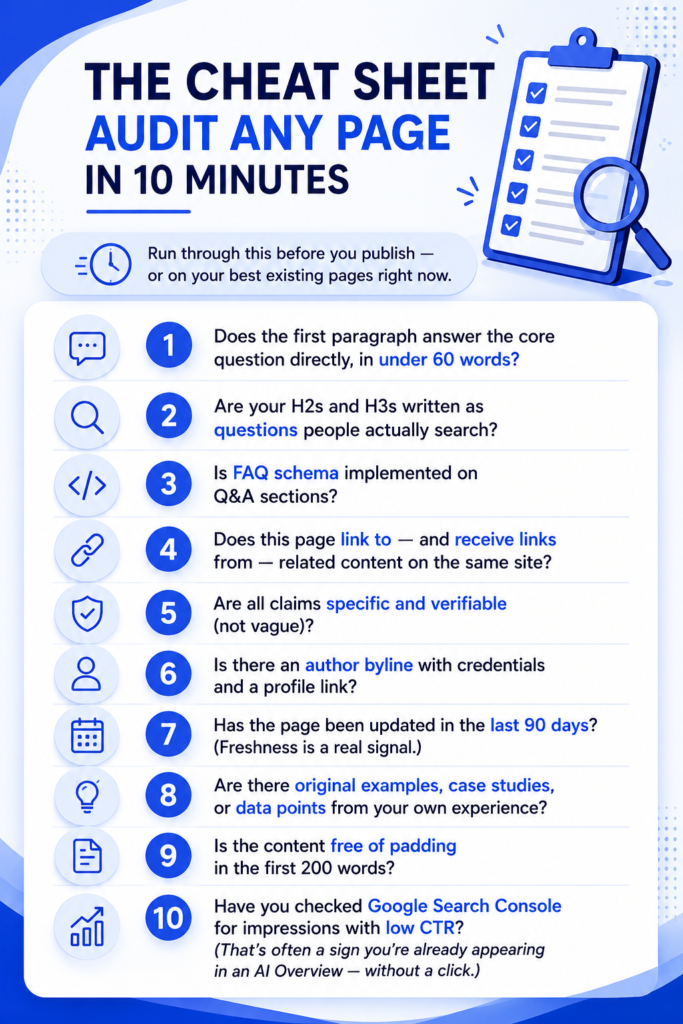
This is the single biggest shift in how I write now, and the one that felt most unnatural at first. Google’s AI scans for pages that answer the query immediately. Your first paragraph should contain the clearest, most concise answer. Burying your answer in the middle of a long introduction will cost you citations.
The old blog format taught us to warm up: introduce the topic, explain why it matters, give some context, then get to the answer around paragraph four. That format is actively working against you now. Lead with the answer. Then explain it. Then expand on it. Think of it like a journalist writing the most important thing first — not a mystery novel.
If someone searches “how to rank in Google AI in 2026,” the first 60 words of your content should have a direct, usable answer. Not “great question, let’s explore this together.” An answer.
2. Build topical authority, not just individual pages.
AI Overviews prefer sources that show depth and breadth on a topic. A single well-written page is less likely to be cited than a site with 10 interconnected articles covering every angle of a topic.
This is the pillar-cluster model — not new advice, but the reason it works has sharpened. When an AI system decides which source to cite, it is evaluating trust. Trust is earned across a body of work, not a single page. If your site has one excellent article on a subject but nothing around it, you’re a one-hit wonder. If your site has a central guide linked to six supporting articles, each going deeper on a specific question — that’s a source that signals it actually knows the territory.
One real case: by optimising 11 pages with interconnected AI-focused design, a team saw 8 of those pages enter the AI Overview panel — reversing expected traffic loss and saving 17 strategic keywords from losing visibility. Not by writing more. By writing connected. (Source: Digivate, 2026)
3. Use schema markup — especially FAQ schema.
This one is technical but worth the effort. Pages with FAQPage schema are 3.2x more likely to appear in Google AI Overviews than pages without structured data, and show 28% higher citation rates across major AI platforms.
Schema is essentially you telling Google’s AI what type of information it is reading, so it doesn’t have to guess. HowTo schema for step-based guides. FAQPage schema for Q&A sections. Article schema for editorial content. The AI is synthesising at scale — anything that makes your content more machine-readable gives you an edge.
A few tools that genuinely help: Ahrefs has solid tutorials on this (their YouTube channel is worth your time). Google’s own Rich Results Test tool is free and direct. Semrush’s content audit feature will flag schema gaps across your existing pages.
4. Make your experience the content, not just the subject.
This is the E-E-A-T point — Experience, Expertise, Authoritativeness, Trustworthiness. The first E was added relatively recently, and the reason it was added is telling. Google recognised that a lot of content was expert-sounding but experience-less. Technically correct. Written by someone who had never actually done the thing.
The December 2025 Core Update was the most consequential of last year: E-E-A-T enforcement expanded beyond YMYL into nearly every category. Reviews and original research content saw the biggest lifts; faceless content farms and thin affiliate sites saw the biggest drops.
For writers, this is actually good news. Your lived experience is the one thing that cannot be replicated at scale. Put your name on your content. Build an author page with credentials. Link your byline to your LinkedIn or portfolio. These are not vanity moves — they are trust signals that feed directly into how AI systems evaluate your authority.
5. Be specific enough to be extracted.
Google is shifting from keyword density to factual precision. AI engines want direct answers. LLMs cross-reference your claims with ground truth data — government sites, academic journals, established wikis. If you claim a statistic that contradicts verified sources, the AI flags you.
Specific claims travel better than general statements. “Content with FAQ schema is 3.2x more likely to appear in AI Overviews” is extractable. “Schema markup can really help your content perform better” is not. Vague content is not synthesisable — and if it can’t be synthesised, it won’t be cited. Use data. Cite your sources. Give concrete numbers. Write like someone who did the research, because you did.
I told you I read 12 blogs and watched 5 YouTube videos to put this together. A few that were worth the time:
Pepper Content’s 2026 AI Overviews playbook at pepper.inc is thorough and has real before/after campaign data.
Ahrefs’ YouTube channel covers the structural side without wasting your time.
The Digivate blog on AIO techniques has a real-world case study worth reading.
Search Engine Land’s AI Overview guide is worth bookmarking for the technical depth.
None of them guaranteed results. Neither will I. Some optimised content appears in AI Overviews within weeks. Other content takes months. What I can tell you is that the writers who will still be here in two years are the ones who stopped treating content as a keyword-filling exercise and started treating it as the most efficient way to demonstrate that a real person with real knowledge who actually understands a real problem.
That’s the whole game. It’s always been the whole game.