
I have been staring at this AI SEO content draft for three days in the summer of May.
Not because – I don’t know what to write. I know exactly what to write. I have lived this. But every time I start, I end up sounding like every other SEO blog on the internet – same old bullet points, subheadings, “Step 1: Do this. Step 2: Do that.” And I swore to myself I wouldn’t do that this time.
So here’s what you’re going to get instead. My SEO story and buried inside it – the actual answer to the question you came here for.
The Internet Before AI Content Explosion
Eight years ago, I started writing for the internet in 2018. I was fresh, a little naive, and completely convinced that if my writing was good. I am genuinely good then it would find its audience. That belief aged like milk in a Delhi summer. But more on that in a bit.
Back then, the rules to get noticed or get traffic were simple. Write long. Write often. Use keywords. Keep the reader on the page. Answer their questions before they finish asking.
The seo content AI conversation didn’t exist – nobody was having it. There was no GEO, no AEO, no AI Overviews. There was just Google, and Google rewarded you if you weren’t stupid about it. The idea of AI SEO content shaping search results wasn’t even part of the discussion.
My content optimization strategy in those days was embarrassingly basic: understand what the person is searching for, write something that genuinely answers it, don’t be boring, and add internal links.
And it worked.
2018 to 2024 – that stretch was honestly the golden era for writers like me. Every major Google update would shake the room, everyone would panic, and then things would settle and the writers who were writing for humans (not just for crawlers) would come out fine. Not always on top. But fine. You could feel when an article was landing. The traffic would tell you. The comments would tell you.
I wrote about software products, SaaS tools, B2B content, technical documentation, and blog posts. I was part of a team at a company that builds software products, and getting our content seen was quite literally part of the business.
My colleague Himanshu – a sharp guy, obsessive about data in that quiet way where you don’t realize how obsessive until he pulls out a spreadsheet at 10 pm.
He was the one always nudging the content optimization strategy from the SEO side while I handled the voice, the narrative, the parts that made articles feel like something a person actually wrote. It was a good arrangement. It worked. Until 2023.
When AI SEO Content Changed Everything
The AI circus arrived and I am not being dramatic when I say none of us were ready.
That’s when the shift toward AI SEO content became impossible to ignore.
I don’t mean we didn’t see it coming. ChatGPT had been a whisper for a while. But the speed at which the landscape shifted, that was the part nobody was prepared for.
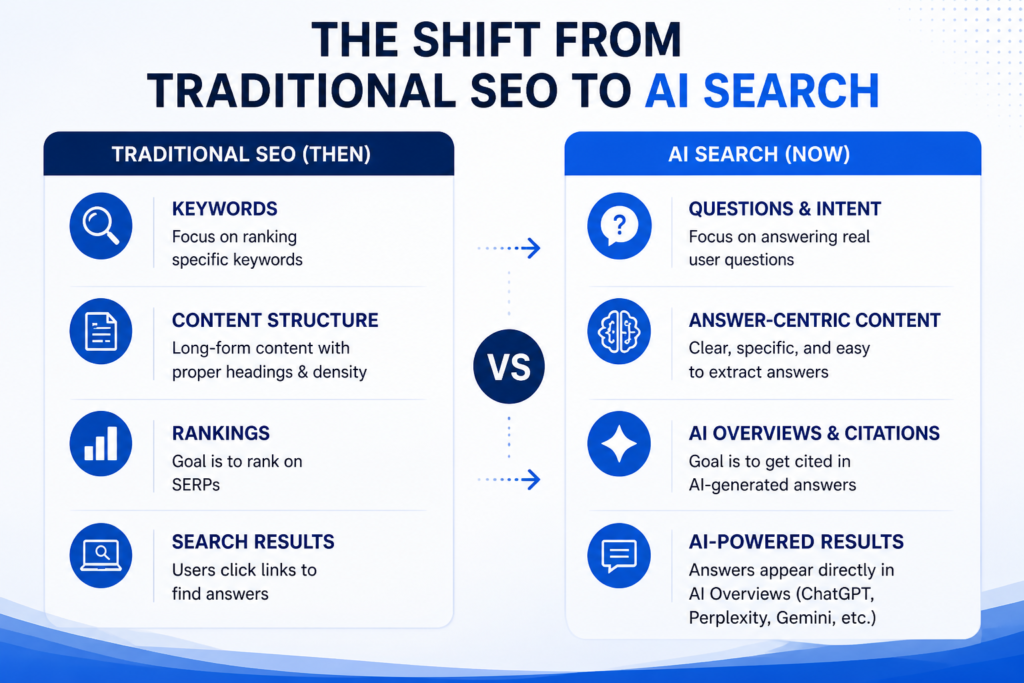
Overnight, every marketing team had an “AI content strategy.” Every freelancer had a new pitch. Every tool promised to 10x your output. And in a very literal sense, the supply of words on the internet exploded. Anyone with access to a prompt box became a writer. Anyone who could edit a ChatGPT output was suddenly a “content strategist.”
I will be honest with you because that’s the whole point of this blog. Initially, I panicked. I am a writer. It is the thing I am. And suddenly, the thing I am felt like it was being automated in real time.
The seo content AI wave wasn’t just in theory anymore – it was eating into actual briefs, actual clients, actual work. And the worst part? It was working. The AI content was ranking. The SERP had never been more crowded or felt more mediocre, and yet that mediocrity was climbing.
What My AI Content Experiment Taught Me
In early 2024, I ran an experiment. I wrote seven blogs completely with ChatGPT- I mean almost entirely, with minimal intervention from me. I treated it like a test. I wanted to know the actual answer, not a comforting version. Five of those seven ranked on the first page within three months.
Can you imagine – Five out of Seven.
That was my first real exposure to how powerful SEO optimization AI can be when applied correctly. I sat with that number for a long time. Because on one hand, it confirmed what everyone was afraid of. On the other hand, it told me something more useful: AI for seo content is a very real lever. But a lever is only as useful as the hand holding it.
Here’s what I noticed about those five that ranked versus the two that didn’t: the ones that ranked had a clear, answerable question at the center. A specific human need.
The two that flopped were written around vague topics that sounded important but served no one in particular. The AI had no idea, because AI isn’t build to have idea – it doesn’t know your audience. That’s the gap most search engine optimization AI strategies fail to bridge. It doesn’t know that your reader is a 34-year-old SaaS product manager who skims everything, hates jargon, and has seven tabs open. It doesn’t know that your reader doesn’t care about “comprehensive solutions” – they care about not getting yelled at in their next standup.
Audience research. That’s the thing AI cannot do.
The Biggest Thing AI Still Cannot Understand
And that was the first real lesson.Hey! Stop me.. What am I Blabbering? You came here because you want to know how to structure your content so AI search results pick it up – or to be precise get sighted on Google AI Overviews, ChatGPT search, Perplexity, whatever is being hyped these days. Okay I promise I will get there. It’s a true promise. But…Understand the base first, brother.
I need you to understand why the base matters, because every content optimization strategy that actually works is built on it.
How AI Search Systems Actually Work
The base is this:
AI search is not magic. It is pattern recognition at scale. These systems rely heavily on existing AI SEO content that has already proven its value, has already been indexed, already been validated by engagement and authority and backlinks and trust signals.
When an AI Overview surfaces an answer about, say, “how to migrate a database without downtime” it is not inventing that answer. It is combining it from pieces of content that already earned their place. Your job is to be one of those pieces.
And the way you do that hasn’t changed as much as everyone is screaming that it has.
Let me tell you about my collague Himanshu’s chapter.
When the AI Overview thing started getting serious and when we started seeing our competitor’s product pages getting cited in AI-generated answers and ours weren’t ! Himanshu and I started spending a lot of time on this.
We work on software products where the stakes are real. It’s not a lifestyle blog where traffic dipping for a month is just annoying. This is our pipeline.
What Content Gets Picked by AI Search Results
So we started pulling apart the content that was getting cited. Most of what we analyzed was not just good writing — it was well-structured SEO content AI systems could understand easily. Not skimming it – actually reading it. And what we found was not what the LinkedIn thought leaders were preaching.
We found that the content being surfaced had certain qualities that kept showing up:
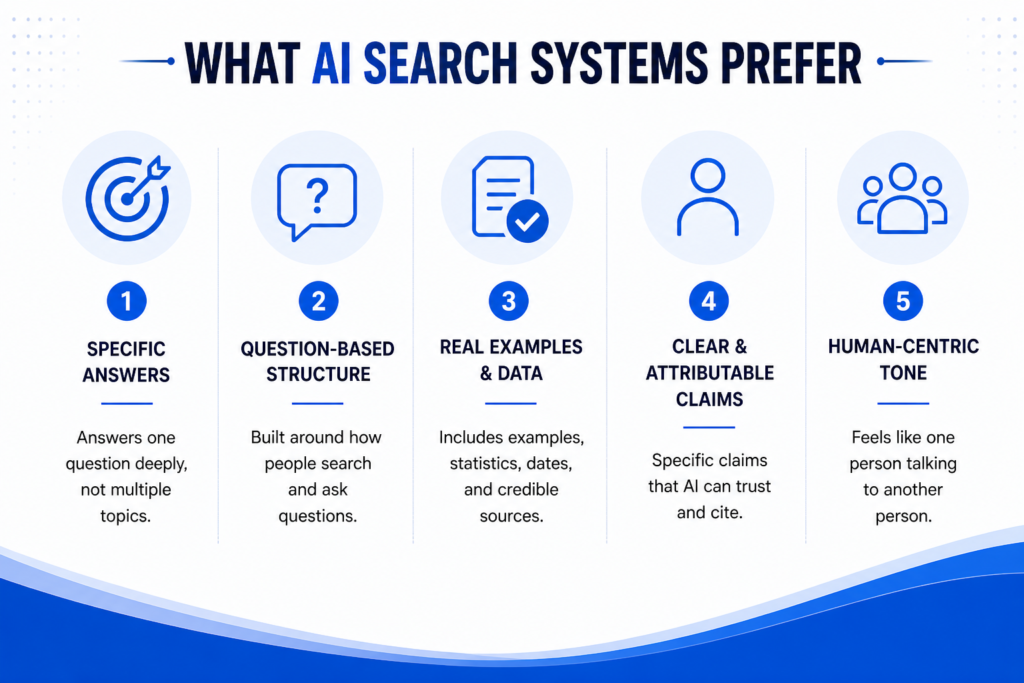
It answered one thing very well.
Not ten things adequately.
One thing, deeply and specifically.
The kind of specific that makes a reader feel like whoever wrote this actually understood their problem.
It was structured around questions, not just topics. There’s a difference between a blog titled “Database Migration Guide” and one titled “How Do You Migrate a Database Without Breaking Production?” The second one is a sentence a human would type. AI search systems are surfacing answers to questions, not summaries of topics.
It had clear, attributable claims. Not vague assertions. Not “many experts believe.” Named things. Real examples. Dates. Data points with sources. Because when an AI system is deciding what to cite, it has a tendency to get attracted toward content that looks like it has done its homework.
It read like one person talking to another person. Not a brand voice. Not corporate we. An actual human perspective. Which was ironic to discover, given that so much AI for seo content advice in 2024 was pointing people toward automation and scale.
The Real Content Optimization Strategy for AI Search
Now here’s the part where I’m supposed to give you the framework. The checklist. The “7 Ways to Structure Your Content for AI Search” list.
Hahaha…. I’m not going to do that. Not because I am lazy to write or I’m being difficult.
But because the framework, if I hand it to you pre-packaged, it will become noise. You will execute the checklist and get mediocre results and wonder why. The real content optimization strategy for AI search is not a checklist. That’s where most SEO content AI approaches go wrong — they optimize format before understanding intent. It is a shift in how you think about what content is for.
Content is not for ranking. Ranking is a byproduct of content being genuinely useful.
I know that sounds like a bumper sticker. But Himanshu and I have been grinding on this for months, running pillar-cluster strategies, restructuring our product pages, rewriting FAQs, creating comparison content, review blogs, testing entity-based optimization – and all the seo content AI playbook stuff – and the single biggest boost we got was not from any technical AI SEO optimization. It was from one product page we rewrote from scratch, where I stopped trying to optimize the page and started trying to make it actually answer the question a confused, unaware and skeptical buyer would show up with.
That page started appearing in AI Overviews within four weeks.
Write for Questions, Not Just Keywords
So if you want the closest thing to a real answer I can give you:
Write for the question, not the keyword. AI search systems looks for answers. Your content has to be shaped like an answer – with a beginning, a specific middle, and a conclusion that doesn’t trail off into nothing. If someone reads your content and still has to go somewhere else to get the actual answer, you’ve already lost.
Be specific enough to be quotable. Not literally quotable – we’re not writing pull quotes. But if an AI system is going to synthesize your content into an answer, it needs clean, discrete facts or tested results it can work with. Vague content is not synthesizable.
Short, specific claims embedded in context is the gold standard.
Stop optimizing structure, Start optimizing understanding.
The biggest mistake I see – the one I made for years – is treating structure as the thing that earns ranking. Headers in the right place. Word count hit. Keywords distributed.
Done? No. not in the era of AI.
Structure should emerge from clarity, not precede it. When you understand your audience’s actual confusion well enough, the structure writes itself.
Use your real experience. The one thing that is genuinely, structurally difficult for AI for seo content to replicate is lived experience and perspective. Not just “here’s a tip” but “here’s what I got wrong.” That texture is what makes content citable. That texture is what makes a reader stay. And staying is spending time on page + return visits. But, shares – is still the signal underneath all the signals.
Final Thoughts on SEO Content AI
I know there’s more to say – I’ll take a break here. Because for me there’s always more to say. But this blog is already doing the thing it set out to do – it has no classic structure, no numbered steps, no conclusion that wraps everything into a tidy bow.
And yet, if you’ve read this far, you’ve absorbed a real content optimization strategy. Because templates fail but experiences don’t. From a person who has been in this long enough to make all the mistakes worth learning from.
I hope the Irony of this blog landed well.
And if it didn’t, well. That’s a feedback signal too. Because in the end, even the best AI SEO content still depends on how well it understands people.