
Summary:
Real estate deals take months to close. Waiting for last month’s traffic report means always reacting too late. SEO forecasting uses past search data to predict demand ahead of time, so content and budget decisions happen before the market moves, not after.
SEO forecasting for real estate means using past data to predict what search demand may look like next.It helps real estate teams plan content and budgets before demand hits, not after. The right SEO forecasting tools can show search volume and forecasts for local terms, not just national trends. US real estate SEO works best when it targets neighborhoods and suburbs, not whole states. A strong real estate SEO strategy also means studying your competitors closely, not just your own site. This guide covers forecasting, tools, and a full competitor research plan you can use right away.
Why SEO Forecasting Matters for Real Estate Teams
Real estate deals take time. A buyer who searches “homes for sale in Round Rock TX” today may not buy for months. This is why forecasting matters so much in this field.
If you only check last month’s traffic, you are always behind. SEO forecasting uses past search data to predict what comes next. This helps you plan content, ads, and even staff needs before demand shows up.
For example, searches for “condos for sale in Miami” often rise every January. Searches for “best school districts in Charlotte NC” tend to climb every March. If you know this ahead of time, you can act early. If you don’t, you miss the window.
What SEO Forecasting Actually Means
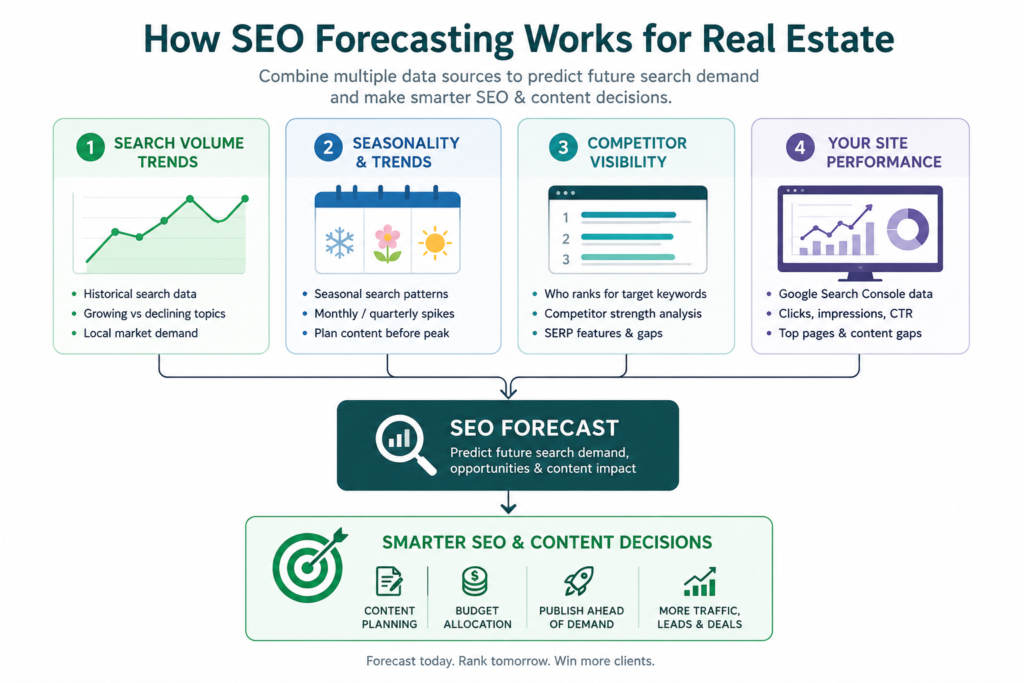
SEO forecasting is not one number. It comes from a few data points working together.
Search Volume Trends
This means tracking how many people search a term each month, and how that number changes over time. This is where you get search volume and forecasts for specific real estate terms. A search like “homes for sale near me” behaves very differently than “3 bedroom house Denver CO under 400k.”
Seasonal Patterns
Real estate searches follow the calendar. Spring and early summer usually bring the most buyer searches in most US cities. Fall and winter often slow down, except in states like Florida or Arizona, where snowbird buyers change the pattern.
Competitor Visibility
This means watching how other sites, like Zillow, Realtor.com, or a local brokerage, rank for the same search terms. If a competitor starts ranking for “best real estate agent in Scottsdale,” that is useful data for your own forecast.
Your Own Site Data
Your site’s past traffic, click rates, and lead numbers show how much of that future search volume you can actually capture. Google Search Console can help you establish this historical baseline by showing the queries that bring users to your site, along with clicks, impressions, and click-through rates.
SEO Forecasting Tools That Work for Real Estate
Not every SEO tool understands real estate. Many miss local search intent, which matters most in this field. Here are tools that actually help.
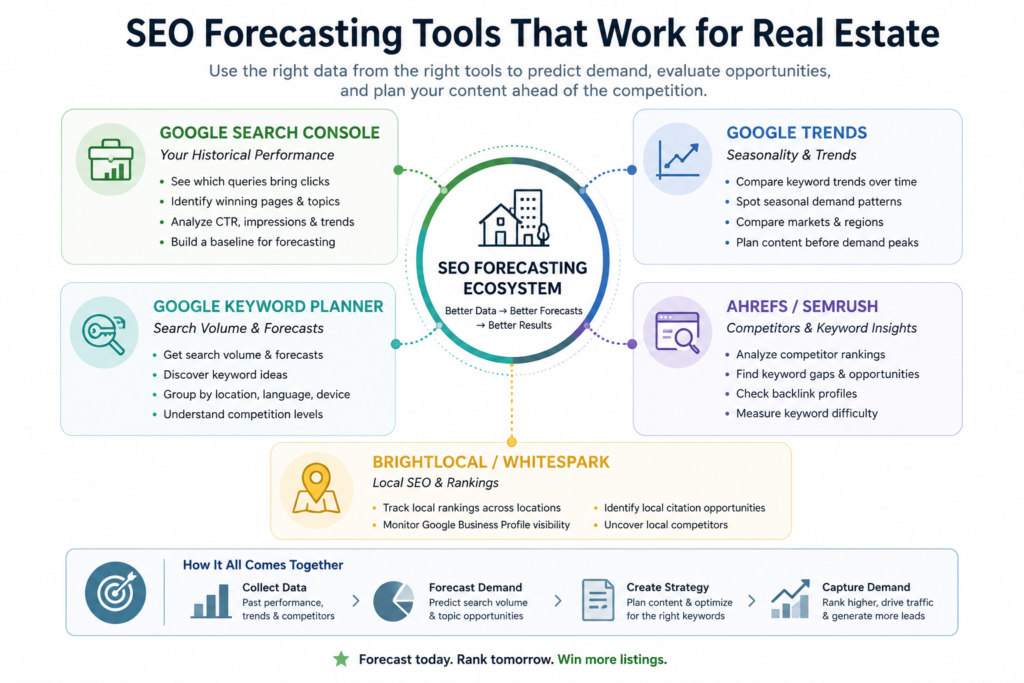
1. Google Search Console and Google Trends
Both are free. Google Search Console shows your site’s real history. Google Trends shows season patterns for local terms. Together, they build a solid baseline.
2. Ahrefs and Semrush
Both tools offer keyword forecasts based on past trends. For real estate, filter by city or metro area instead of using national numbers.
3. Google Keyword Planner
Even without running ads, Google Keyword Planner is one of the best tool to get search volume and forecasts at a local level. It works well for zip code or neighborhood searches.
4. Moz Pro
Moz is known for its Domain Authority score, but it also tracks keyword rankings and search volume over time. It is a strong second opinion next to Ahrefs or Semrush.
5. Local SEO Tools (BrightLocal, Whitespark)
These tools track local map rankings. This matters a lot in real estate, since many searches include “near me” or a neighborhood name.
Use more than one tool. A single forecast is just one data point. Two or three tools together give you a clearer picture of where demand is headed.
Competitor Research: The Part Most Real Estate Teams Skip
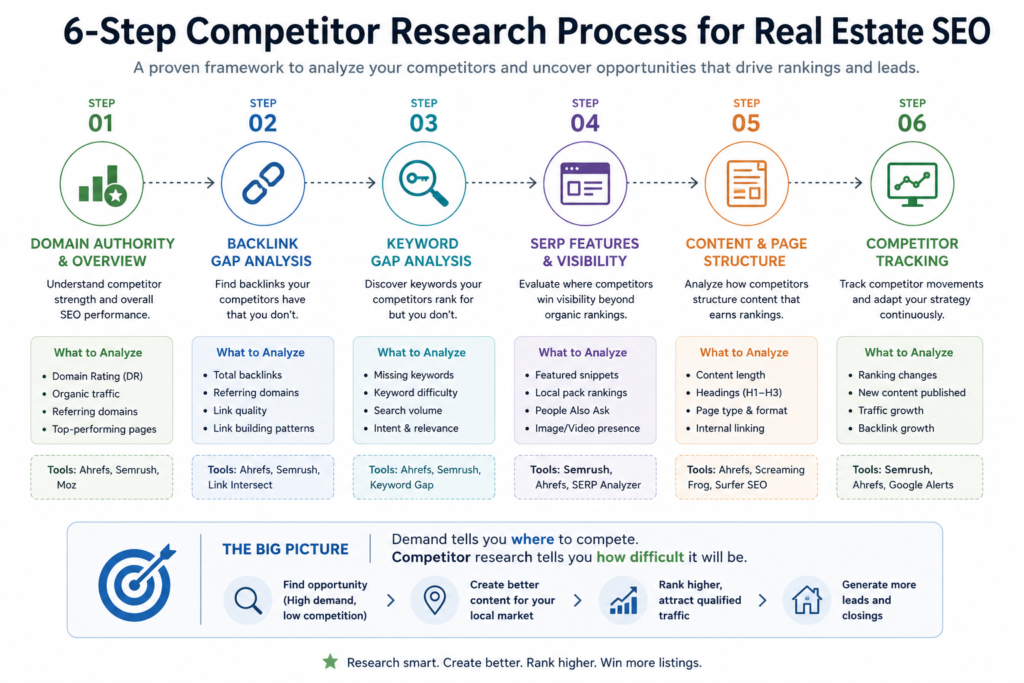
Forecasting tells you where demand is going. Competitor research tells you who already owns that demand, and how hard it will be to take it. Most real estate marketers skip this step or do it once and forget it. Here are six ways to do it properly.
1. Check Domain Authority Before You Set Targets
Before you chase any keyword, check the Domain Authority (DA) of the sites already ranking for it, using Moz’s free DA checker or Moz Pro. If the top five results all have a DA above 60, like Zillow or Realtor.com, ranking for that exact term will take a long time. If the top results are local brokerages with a DA between 15 and 30, you have a real chance. This one check saves months of wasted effort on the wrong keywords.
2. Run a Backlink Gap Analysis
A backlink gap analysis shows you which websites link to your competitors but do not link to you. Tools like Moz Link Explorer, Ahrefs, or Semrush all offer this feature. Enter your domain and two or three competitor domains, and the tool will show shared linking opportunities. In real estate, this often means local news sites, chamber of commerce pages, school district blogs, and community associations. These are easier links to earn than generic guest posts.
3. Run a Keyword Gap Analysis
A keyword gap analysis compares your site against competitors to find keywords they rank for that you do not. Ahrefs and Semrush both have a “Keyword Gap” or “Content Gap” tool built for this. For real estate, this usually reveals neighborhood-level terms, school district searches, or “cost to sell a house in [city]” style questions that your competitors have already captured. These gaps are often your fastest wins, since the demand is proven and the content just needs to be built.
4. Study the SERP Features, Not Just the Rankings
Rankings alone do not tell the full story. Check who owns the featured snippet, the local map pack, and the “People Also Ask” box for your target terms. If a competitor holds the local pack for “real estate agent in Denver,” that spot needs a stronger Google Business Profile strategy, not just better content. Each SERP feature needs a different fix, so treat them as separate goals.
5. Break Down Competitor Page Structure
Pick the top three ranking pages for a keyword you want, and look at their structure. Check word count, headings, whether they use schema markup for listings, and how they answer buyer questions. This is not about copying them. It is about understanding what Google is already rewarding for that search, so your page can match or beat that standard.
6. Track Competitor Content Over Time
Set a monthly reminder to check competitor blogs and listing pages for new content. Tools like Ahrefs and Semrush can alert you when a competitor publishes new pages or gains new rankings. In real estate, competitors often publish seasonal content early, like “best time to sell a house” guides. If you see this pattern, plan your own version even earlier next year.
How to Build a Real Estate SEO Strategy From This Data
Data only helps if you use it. Here is how to turn a forecast and a competitor audit into a working real estate SEO strategy.
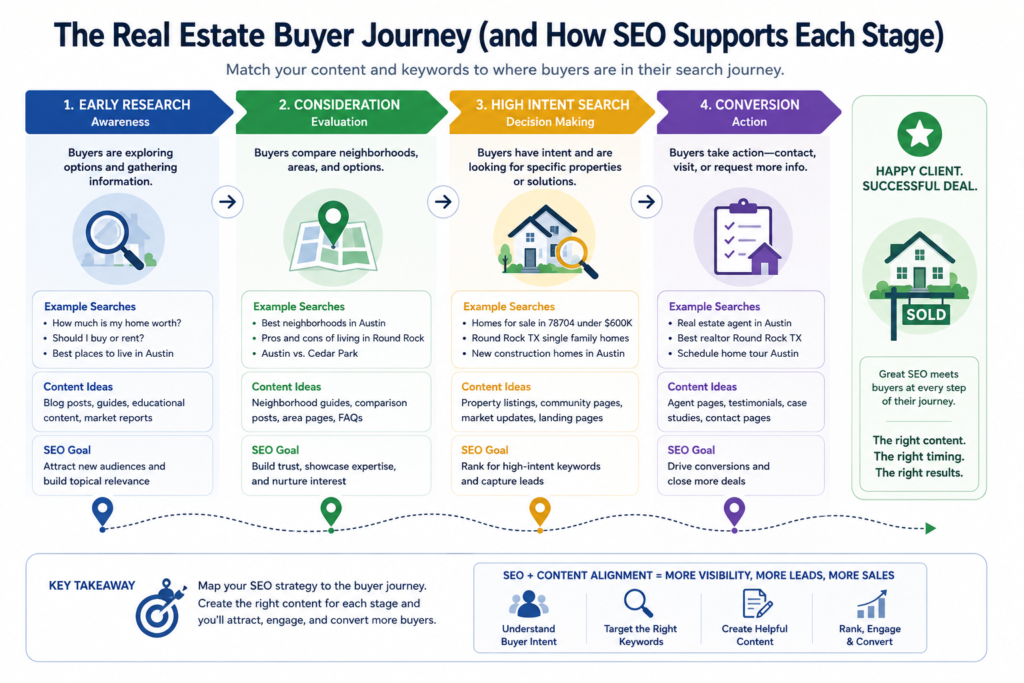
1. Match Keywords to the Buyer Journey
Search intent changes as a buyer gets closer to a decision. Early searches look like “how much is my home worth in Austin.” Later searches look like “homes for sale in 78704 under 600k.” Your forecast should show which stage is growing in your market, so your content can match it.
2. Focus on Local Pages, Not Broad Ones
A broad page for “homes for sale in Texas” will rarely win. Forecasting data usually shows stronger results at the neighborhood level, like “homes for sale in Cedar Park TX” or “townhomes in East Nashville.” These pages convert better because the intent is clearer.
3. Publish Content Ahead of the Season
If your data shows a rise in “best time to sell a house in Phoenix” every February, publish that content by December. SEO takes time to rank, so your content needs to lead the trend, not follow it.
4. Close Keyword and Backlink Gaps First
Use your gap analysis to prioritize content. Keywords your competitors already rank for, with proven search volume, are safer bets than brand new topics with no data behind them.
5. Connect Forecasts to Leads, Traffic alone doesn’t help
Traffic alone does not help an agent or brokerage. Pair every forecast with a real conversion estimate, so your growth numbers connect back to real business results.
A Real Example
Take a mid-size brokerage in the Tampa Bay area. Their data shows that searches for “waterfront homes for sale in Tampa” rise steadily from January to April each year. A quick Domain Authority check shows the top-ranking sites are mostly local competitors with a DA under 35, not national portals. This means the keyword is winnable.
A keyword gap report also shows that a competitor ranks for “waterfront home inspection checklist Tampa,” a term this brokerage had never targeted. Instead of waiting until March to publish content, the team starts in November. They build neighborhood pages, close the keyword gap, and earn backlinks from a local news site found during the backlink gap analysis. By February, when the search spike hits, their pages are already three months old and ranking well.
This is the real value of forecasting combined with competitor research. It is not about predicting the future with full certainty. It is about knowing exactly where to aim before you start.
Common Mistakes to Avoid
- Using national data for local markets. Search habits in Boise do not match Brooklyn. Build your forecast at the city or zip code level.
- Chasing keywords without checking Domain Authority. A high search volume keyword is worthless if you have no real chance of ranking for it soon.
- Ignoring listing turnover. Real estate content ages fast because listings sell or expire. If you ignore this, your forecast will overestimate future results.
- Treating forecasts as one-time reports. Markets shift. Rates change. A forecast from last year is old news, not a live plan.
Skipping CRM data. Search volume means little without knowing how many searches turn into real leads or sales. Pull in your CRM data for a clearer picture of ROI.
How to Get Started
You do not need a complex system to start. Follow these steps.
- Pull 12 to 24 months of Search Console data for a baseline.
- Use Keyword Planner or Ahrefs to get search volume and forecasts for your top 15 to 20 local terms.
- Check the Domain Authority of your top three competitors using Moz.
- Run a keyword gap and backlink gap analysis against those same competitors.
- Publish or update content one full season ahead of demand, starting with your biggest gaps.
SEO forecasting and competitor research will not replace local knowledge or client relationships. But when you pair them together, your website becomes a real growth engine. It stops reacting to the market and starts leading it.
Key Takeaways:
- Forecasting is built from four data layers: search volume trends, seasonal patterns, competitor visibility, and your own site’s historical performance.
- Tools that work for real estate: Google Search Console, Google Trends, Ahrefs, Semrush, Google Keyword Planner, Moz Pro, and local tools like BrightLocal or Whitespark. No single tool gives the full picture.
- Competitor research done right: checking Domain Authority before targeting a keyword, running backlink and keyword gap analysis, studying SERP features like the local map pack, and reviewing competitor page structure.
- Hyperlocal beats broad targeting: neighborhood and suburb-level pages consistently outperform city-wide or state-wide pages, because buyer intent is sharper.
- Timing matters as much as targeting: content needs to publish a full season ahead of a forecasted demand spike, since SEO takes time to index and rank.
- Traffic without leads isn’t success: every forecast should tie back to a real conversion estimate, ideally connected to CRM data.