Summary
Does Google update affect your ranking? Yes, but rarely in the dramatic way most business owners imagine. Google updates can affect rankings, traffic, and visibility, but they rarely destroy good content overnight.
The real challenge for businesses isn’t surviving algorithm updates—it’s understanding that SEO is a long-term investment that requires patience, consistency, and realistic expectations.
If you’re a business owner wondering why rankings fluctuate after every Google update, this article shares a marketer’s perspective on what actually happens behind the scenes.
Intro
A Personal Perspective on Google Updates and Content Creation
You know what happened to me last week? I met a content strategist. Spent 9 years in this field. Thirty minutes together and we landed on the same uncomfortable truth: Google updates feel like a reset button.
Every single time.
The Pattern Nobody Talks About
Here’s what I notice—and honestly, I think I’m right about this, even if we can debate it:
Google launches an update. The industry panics. Strategies that worked for 5 years suddenly feel outdated. And then… we all go back to square one.
Not because we’re doing everything wrong. But because the rules keep shifting.
It’s like Google keeps rewriting the game while businesses are still learning how to play it.
My friend has the same view. But here’s the thing—I can’t tell you exactly what gets updated. I can’t explain the algorithm in a pretty diagram. What I can tell you is what I feel in the results.
And the results speak obvious.
The Silence We Keep
May 2026 update just dropped. Google says something about FAQs—they don’t care about them anymore. Or maybe they do. Or maybe it depends on your niche. Who knows?
Google Says. Google Does. And somewhere in between, marketers are expected to explain the results to business owners who understandably want answers.That’s the real headline.
Part of that challenge comes from the fact that search itself is changing. Today, many marketers are no longer focused only on rankings—they’re also trying to understand how to get cited in AI-powered search experiences and Google AI Overviews.
As a content creator, as an SEO manager, we’re caught between a rock and a brand new algorithm update. The confusion is real. And yes, maybe Google’s updates are complex. Maybe they’re not. But complex or simple—nobody tells us clearly what actually changed.
So we keep working the same way. And sometimes it works. Sometimes it doesn’t.
Why Google Updates Feel So Personal
Why I Still Love This Job
Look, I know my reality. I’m not chasing millions. Last year, our livegodigital project landed 5,000 views. Five thousand.
My new strategist friend? He claims he’s about to pull a million views annually. That’s beautiful. I’m not jealous. I’m genuinely happy for him. And I’m also happy with my 5,000.
Because here’s what most people don’t get: I started learning inside a 10 by 15 small apartment in Poland. No fancy office. No team. Just me, a laptop, and the confusion.
And you know what? That’s where I fell in love with this work.
I understand content. I understand strategy. I understand content + strategy. What I don’t understand is how to make something “go viral” on command—and honestly, I don’t think anyone really does, even if they claim to.
The Mistake Most Businesses Make About Content
My friend Himanshu taught me (and he’s written extensively about the May 2026 Google Core Update—you should read his analysis, it’s thorough)
They expect every blog to go viral. Every article to bring a million visitors. Every content piece to be rocket science.
That’s foolish.
And that’s why my strategist friend lost his job. Not because he wasn’t talented. But because expecting instant results from content is like expecting a tree to produce fruit in two weeks.
Content is not fast food. Content is a tree.
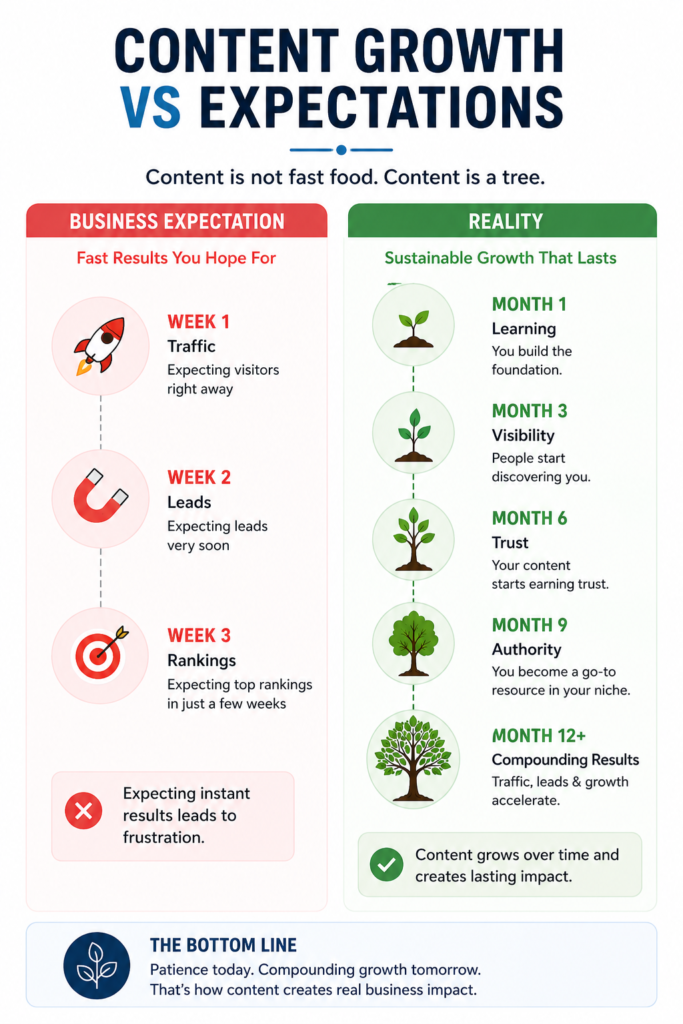
If you’re a business owner, this is probably the hardest part of SEO to accept. Paid advertising can generate visibility tomorrow. Content marketing rarely works that way. Most content efforts compound slowly over time, often producing results months after the work was completed.
What Content Marketing Actually Looks Like Behind the Scenes
Here’s What I Do (And Why It Works For Me)
I write the way I write. Sometimes my thoughts skip. Sometimes they slip. But I structure the blabber. That’s my method.
I rush to ink down my thoughts whenever I get a topic. I find a problem I relate to. I understand it. I try to find the solution—even if I’m not 100% certain.
It’s difficult. It’s confusing. But it’s fun because I’m just a writer who loves when my work finds its people.
And yes, people find my content. Not millions. Just the right ones.
What Google Updates Actually Mean
Think of it this way: Google updates are like software updates for your business.
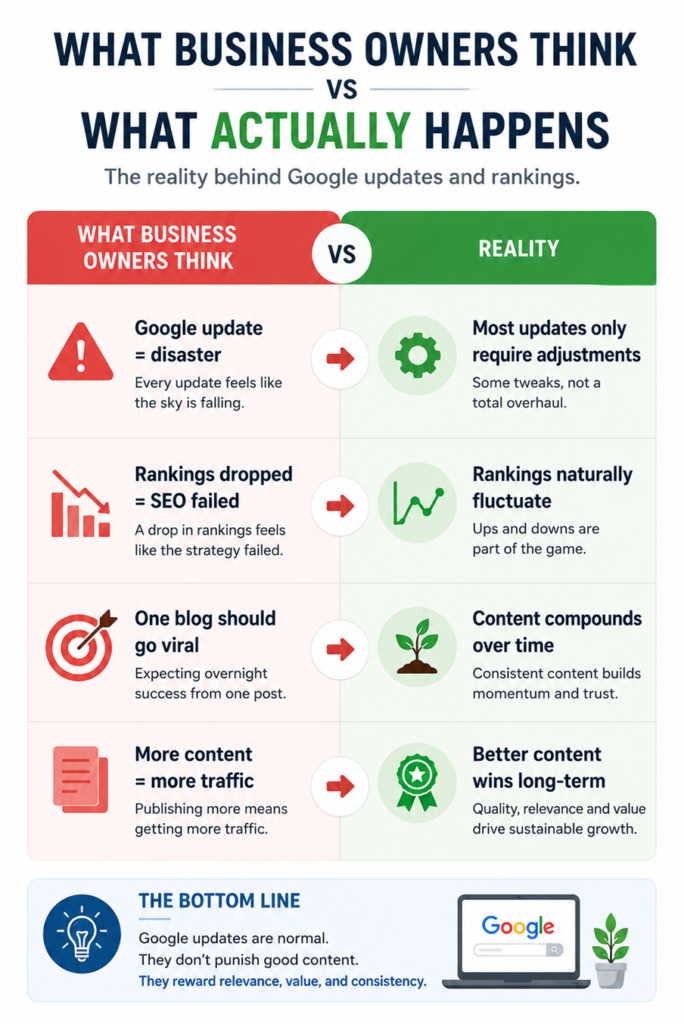
A Google update doesn’t mean your content is broken. It means the environment around it has changed.
Your content isn’t suddenly bad. Your website didn’t become a ghost. What happened is—the software running behind the scenes got adjusted, and you need to adjust too.
But here’s the beautiful part: You don’t have to chase the algorithm.
You have to love what you write.
I didn’t panic with the May 2026 update. I made minor changes. Minor fixes. Because I was already writing in my own flow. I wasn’t writing for Google. I was writing for the people who find Google. And if you’re running a business, that’s usually the response you want from your marketing team as well. Not panic. Not complete website overhauls. Just thoughtful adjustments based on real data and long-term goal
The Real Answer Business Owners Need to Hear
Does Google update affect your ranking? Yes. Absolutely. But not the way you think.
It doesn’t kill your work. It doesn’t make your effort worthless. It might shift where you appear, sure. But if your content is built on love—love for your topic, love for your reader, love for actually solving their problem—a Google update is just a minor hiccup.
Sometimes your traffic dips. Sometimes it explodes. That’s the adrenaline of content creation.
What I’ve learned:
1. Google is a third party. Not your boss. Take ownership of your content.
2. Time is everything. Launch a website like you’re starting a relationship. It needs love. It needs patience.
3. Viral is not a strategy. Consistency, authenticity, and genuine value are.
4. Your English doesn’t matter. Your truth does.
5. Updates are normal. They’re not apocalypses.
Final Thoughts
Read My Version (or Don’t)
I know most humans won’t get this. I know you have no time. But if you do have time? Read this again. My friend Himanshu wrote the comprehensive technical breakdown of the May 2026 updates—you should read that too. Understand the mechanics.
But remember: My version is the heart of it.
The heart is that Google updates are like weather. They change. You adapt. But you don’t stop loving what you do.
Stay happy. Love your content. Love your family. Love your friends. Love the world.
Time will do the rest.
Because sometimes, we just need to write the way we write, structure our thoughts, and trust that the right people will get it. They always do.
Key Takeaways
- Google updates can influence rankings, but they don’t automatically make good content worthless.
- Ranking fluctuations are a normal part of SEO and content marketing.
- Businesses often expect content results faster than content naturally works.
- Consistency usually outperforms chasing every algorithm update.
- Good marketers focus on adaptation, not panic.
- SEO success is built through patience, trust, and long-term content creation.
- Google updates should be treated as adjustments, not disasters.