Summary
Can AI content rank on Google? Yes, 100% AI-generated content can rank on Google.
Google does not rank content based on who (or what) wrote it. It ranks content based on usefulness, relevance, and its ability to satisfy the user’s search intent.
However, publishing AI content alone is not enough. Content structure, technical SEO, topical relevance, and genuine value still play a major role in rankings.
AI can generate information. What often separates great content from average content is the human perspective behind it.
Intro
I procrastinated for one week before writing this. And you know what? That’s very on-brand for me. I enter into this thing called analysis paralysis, though I just call it procrastination. It’s the easy word.
But here’s the thing: this is an easy topic. Or maybe it’s not a topic at all. It’s just a question with a one word answer. And it’s an answer that most enterprises, content managers, SEO managers, and lazy writers who lost their voice want to hear. They want to hear YES.
I know you want to hear YES too.
And honestly, why not? If I write something and you write something and hundreds of other writers write something, and then an AI reads all of it and rewrites that same thing a billion times over… how would you ever figure out who actually wrote what?
Here’s where I get scattered..
SEO writing isn’t something where you need emotion or empathy. AI is unbeatable at writing guides. Even if I got reincarnated 100 times, I wouldn’t beat AI at guide writing. But here’s what nobody talks about: AI isn’t writing. The human who designed it is writing. Human designed AI. Human designed content. And human content designed AI content.
But that’s the thing about being human, my thoughts are random and unplanned. In one paragraph I’m comparing human content with AI. In the next I’m angry that AI trained itself on my content for the past ten years. I don’t know what I’m about to write in the next paragraph. I don’t even know if I know. It’s getting crazy. It’s getting crazier. Especially when I see AI write so much better and more useful content than I ever could.
So let me just ask the question that brought you here.
Google’s Position on AI-Generated Content
What Do Google’s AI Content Guidelines Say?
According to Google’s guidance on AI-generated content, using AI is not against Google’s policies. Google focuses on the quality of the content rather than the method used to create it.
In other words, AI content is not automatically rewarded, nor is it automatically penalized. If the content is useful, original, and satisfies the reader’s search intent, it can rank just like human-written content.
This is why the debate around AI content often misses the point. The real question is not whether AI wrote it, but whether it genuinely helps the person searching.
Let’s say you’re a marketer. Or an SEO person. Maybe you don’t know how to write. Maybe you’re just too lazy to. You’ve been putting out AI content for two years now hoping it would rank. But it didn’t, right? That’s why you’re here searching for this exact same thing.
At this point, many business owners and marketers start wondering: Will AI content hurt my website? The answer is usually no. Using AI to create content is not inherently harmful. Problems arise when content is published without fact-checking, originality, or a clear understanding of what the reader actually needs.
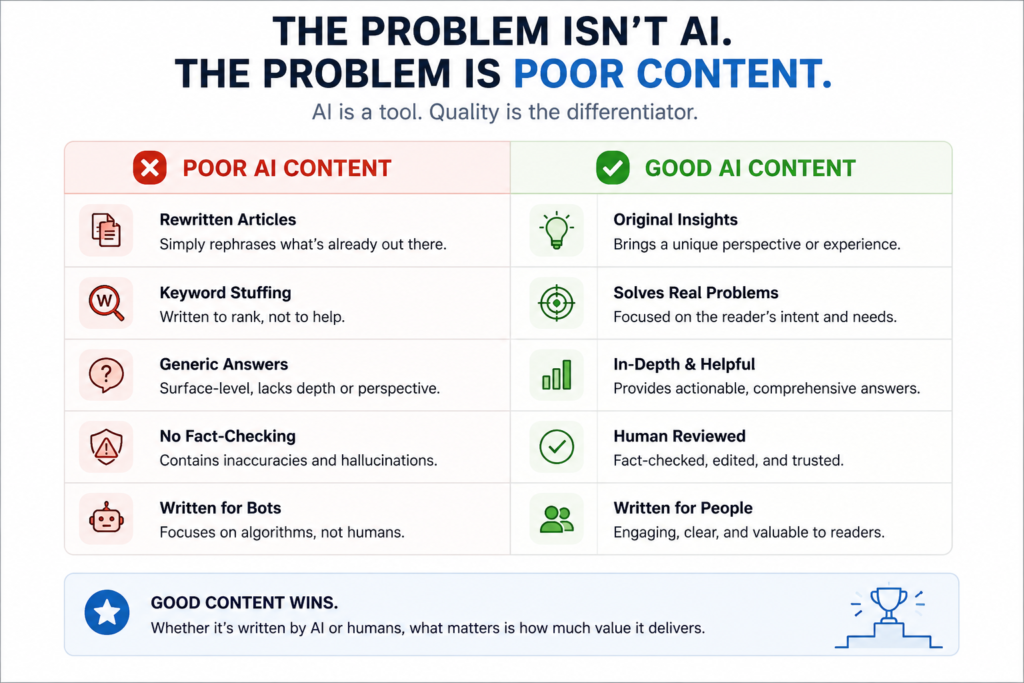
Here’s the truth: the problem was never AI. The problem was that you took writing very lightly. This is where many marketers ask another question: Is AI content bad for SEO? Not really. AI content itself is not the problem. The real issue is low-quality content that exists only to fill pages rather than help readers. Whether content is written by a human or an AI, it still needs to provide value.
And that’s where many people get it wrong.
You thought anyone could do it. Or you wrote for the chatbots instead of for humans. You forgot the most important thing, the human on the other side. But even if you remembered that, even if you kept that in mind… would it rank? No. Because ranking is a mix of so many things.
The real problem is that Google doesn’t use humans to decide what ranks. Everything gets left to the bots. They extract information. They extract everything useful. And they still forget the human element.
I know it’s confusing. That’s because humans make mistakes and humans made AI and now AI makes mistakes too. Hallucination. That’s the word I hear most.
If you’re wondering, “Will AI content hurt my website?” the answer depends on how it’s used. Publishing low-quality content at scale can create problems, but using AI to assist with research, structuring ideas, or creating first drafts does not automatically harm your website’s search visibility.
Now the second scenario
You’re a lazy writer like me. Well, I’m just too smart, so I call it something different. But you don’t want to write. You also don’t want to lose your value in a crowded job market. For people like us, AI is a hellhole. It’s pushing those of us with actual passion to write something real towards poverty.
Yeah, you didn’t expect to read the word “poverty” in an article about AI content ranking. That’s how random the human mind is.
Here’s the real talk: for you and me, it’s better if AI content doesn’t rank. Because if it does, we lose the only skill we spent 10, 15, 20 years building. But that won’t happen.
I wrote. You wrote. AI wrote. Who cares? The person who came here looking for a solution doesn’t care about editorial pieces like this one. They just want answers.
But will my article rank? No, probably not. And that’s because ranking requires so much more – proper structure, H2s and H3s, semantic indexing, LSI keywords, schema, and a hundred other things that Google bots read and decide everything on.
I know it’s risky for me to say this out loud. I rely on content for my income. But if your content is unique, if it adds real value for readers, if it actually resolves their query and doesn’t just look randomly random like this piece…
It should rank. No matter who wrote it.
Could be me.
Could be you.
Could be AI.
The difference is whether you actually know how to create structure and understand your reader.
I’m not a grammar nazi at this point. Honestly, I don’t even know how to end this blog. But here’s what I know:
AI knows everything before writing a single word. AI knows exactly what the last line will be before it starts. It’s not random. But this? This is random. Because I’m human and I make mistakes and I write things that leave you thinking, and that’s what human content does. It leaves your brain working.
So what’s the actual answer?
The short answer is yes. But will it compete with human content that actually understands who it’s writing for? No.
AI doesn’t fail at structure. It doesn’t fail at keywords or technical setup. AI dominates at guides and tutorials.
But AI fails the moment you need something that’s actually been lived. Something that comes from understanding your reader as a real person.
You can’t automate knowing who you’re writing for. You can’t automate a perspective that comes from 5, 10, 15 years in a field. You can’t automate that random thought that suddenly becomes the hook that makes someone stop scrolling and think “oh shit, I never thought about it like that.”
So yes, AI content can rank. But it only wins in a world where it doesn’t have to compete with actual humans writing for actual humans. The moment you have people who understand the question AND understand who’s asking it – AI becomes just another piece.
Not better. Not worse. But different.
And different doesn’t win. Understanding wins. Connection wins. The human element wins.
Even if that human element is messy and unpolished and makes you want to flip a table because why is there a paragraph about poverty in an SEO article?
Conclusion
The debate around AI content often focuses on the wrong question.
The real question is not whether AI can write content that ranks. The answer to that is already yes.
The more important question is whether the content actually understands the person reading it.
AI can generate words, structure information, and answer questions at scale. But understanding a reader’s frustrations, experiences, and motivations still comes from human perspective.
In the end, Google rewards content that helps people. Whether that content is written by a human, an AI, or a combination of both matters far less than the value it delivers.
The future of content is unlikely to be human versus AI. It’s more likely to be human understanding supported by AI efficiency. So, can AI content rank on Google? Absolutely. The real question is whether the content helps the person searching.
Key Takeaways
- Yes, 100% AI-generated content can rank on Google.
- Google evaluates content quality, usefulness, and relevance rather than its method of creation.
- AI is highly effective for structured content such as guides, tutorials, and informational articles.
- Rankings depend on multiple factors, including content structure, search intent, technical SEO, and topical authority.
- Human perspective, experience, and original insights can help content stand out in competitive search results.
- The question is no longer whether AI content can rank, but whether it genuinely helps the person searching.