Summary:
Gemini 4 Carbon is Google’s latest AI model, highlighting advances in coding, cybersecurity and complex, multi-step tasks. While Gemini has not designed specifically Carbon 4 for marketing, its capabilities reflect a broader shift towards agentic AI in marketing workflows and why most marketers are using it today. Here’s what rising marketers should understand about this development and how to prepare for the changing role of AI in digital marketing.
It Bridges the Gap for a Multitasker Google AI
Gemini 4 Carbon is another indication that the development of artificial intelligence is moving quickly. But its announcement raises a question that goes beyond Google’s latest model: What happens when AI becomes capable of handling increasingly complex work rather than simply responding to individual prompts?
Until recently, many marketers primarily used AI as an assistant. They asked it to research a topic, suggest keywords, write an article, prepare social media captions or summarise campaign performance. The marketer still connected these activities, checked the results and decided what to do next.
Google’s Gemini 4 Carbon features announcement puts a different capability in the spotlight: sustained, multi-step execution. Google says its teams have seen the model work through complex engineering problems for extended periods, including finding the root cause of bugs and developing fixes across large codebases.
That does not mean Carbon can independently manage SEO, advertising or an entire marketing department. Its demonstrated strengths are primarily in engineering and cybersecurity.
However, the development is worth watching because marketing organisations are already exploring how agentic AI in marketing could change the way work gets done.
For marketers, the important question is no longer just which AI tool can write faster. It is whether they understand how to work with AI systems that can increasingly take responsibility for connected tasks.
1. What Is Gemini 4 Carbon?
Gemini 4 Carbon is Google’s latest frontier AI model, announced on October 28, 2026. Google describes it as its strongest model so far, with improvements in long-horizon capabilities, coding, agentic tasks and cybersecurity.
It builds on Gemini 4 Argon, which Google introduced approximately two weeks earlier.
The key difference highlighted in the announcement is Carbon’s ability to work through complex, multi-step engineering problems over extended periods.
For example, Google says its internal teams have observed Carbon:
- Investigating subtle bugs across large codebases.
- Identifying the root causes of technical problems.
- Developing and applying code patches.
- Continuing through unsuccessful attempts rather than stopping at the first obstacle.
- Handling challenging engineering tasks that require several connected steps.
It’s different from asking an AI assistant to generate a short piece of code or explain an error message. Instead, the model is designed to work towards a more complex objective.
What makes Gemini 4 Carbon different?
Because Google has highlighted key improvements with Gemini 4 carbon across several areas
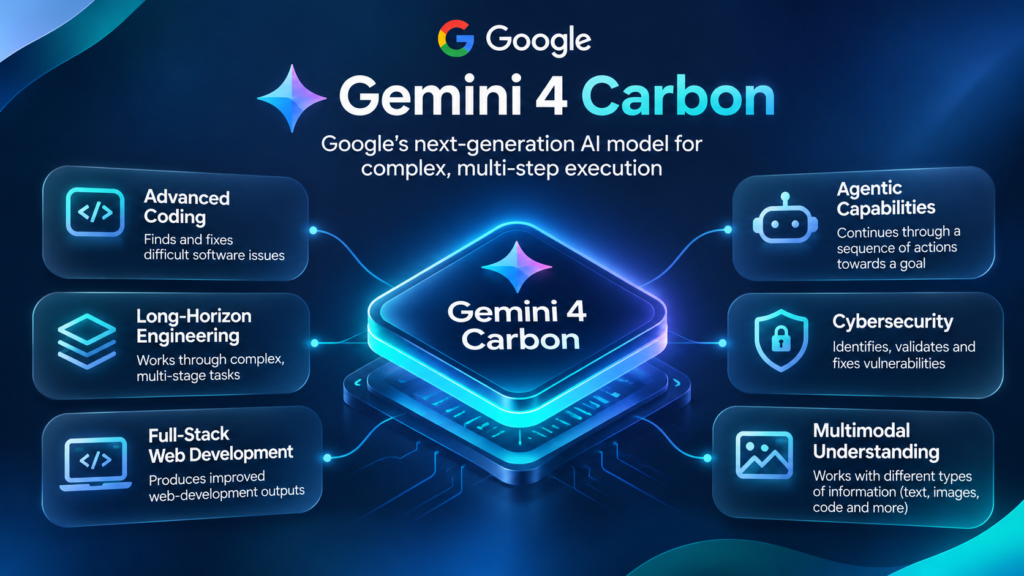
| Capability | What it means |
| Long-horizon engineering | Working through complex tasks involving multiple stages |
| Advanced coding | Finding and fixing difficult software problems |
| Agentic capabilities | Continuing through a sequence of actions towards an objective |
| Cybersecurity | Identifying, validating and fixing software vulnerabilities |
| Full-stack web development | Producing improved web-development outputs |
| Multimodal understanding | Working with different types of information beyond text |
One of Google’s notable claims is that Carbon can sustain certain engineering tasks for days in its internal testing environments.
This is an important development, but it needs context. It does not mean every user can currently assign Carbon an objective and leave it running independently for days. These observations come from Google’s internal engineering environments.
WIIFM – What’s In It For Marketers?
The real question is what’s in it for marketers? In the near future, maybe 3 to 6 months AI development will eventually influence how complex and professional AI marketing workflows are organised. The technology is moving towards systems that can do more than produce isolated outputs.
The challenge for businesses will be determining which tasks can be delegated, how those tasks should be supervised and whether the results actually create value. However, it is important to separate demonstrated capabilities from possible marketing applications.
Google has not demonstrated that Carbon can independently run SEO campaigns, manage advertising budgets or coordinate a complete marketing department.
However, its focus on complex engineering and long-running tasks gives us a reason to examine where more capable agentic systems could eventually influence marketing. We have separated these applications into five broad categories.
A. Marketing workflows could become more connected
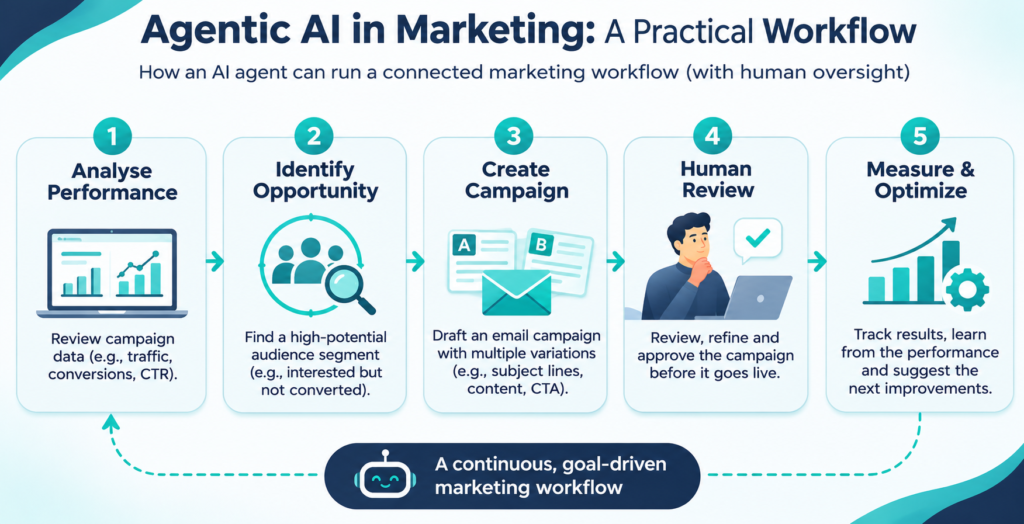
Most marketing teams still use AI for individual activities. An SEO professional might use one tool for keyword research, another for content outlines and another for analysing website performance. The marketer remains responsible for connecting the results. In a AI marketing workflow, these activities could potentially become part of a connected process.
For example:
Research > Opportunity identification > Strategy > Content preparation > Review > Performance monitoring
A suitably configured system could potentially assist with multiple stages rather than waiting for a separate instruction at every step. However, this would require access to relevant data, suitable integrations, clear instructions and appropriate approval mechanisms.
What marketers should learn: Start thinking about using Gemini Carbon 4 for marketing as a collection of connected workflows, not simply a list of individual tasks.
B. Technical SEO and website operations could become easier to coordinate
Carbon’s improvements in coding and engineering are particularly interesting for marketers who regularly work with developers. Technical SEO often involves more than identifying an error. A problem may require examining website templates, understanding the underlying code, identifying the root cause, preparing a fix and checking whether the change resolves the issue. More capable AI systems could eventually assist with several of these steps.
Potential applications include:
- Investigating recurring technical SEO issues.
- Analysing website templates.
- Preparing code changes for developer review.
- Troubleshooting tracking implementation.
- Building reporting dashboards.
- Testing website functionality after approved changes.
For example, imagine a website with hundreds of pages containing inconsistent metadata.
An AI system with suitable website access and technical tools could potentially help identify recurring patterns, prepare corrections and validate the results.
But identifying an issue is not the same as deciding the correct business solution. A missing canonical tag, for example, may require a different response depending on the website’s architecture and indexing strategy. Human review remains important before implementing consequential changes.
C. Marketing analysis could become more action oriented
Many marketers already use AI to summarize reports from Google Analytics 4, Google Search Console and advertising platforms. But summarizing data is only one part of analysis.
The more important questions are:
- Why did organic traffic decline?
- Which landing pages are generating fewer enquiries?
- Are certain campaigns attracting visitors who do not convert?
- Is the problem related to traffic quality, messaging or the conversion journey?
- What should the marketing team investigate next?
More capable AI systems could eventually help connect data analysis with investigation and recommended actions.
For example, a workflow might examine a decline in organic enquiries, compare landing-page performance, inspect relevant search queries and prepare a list of possible causes. The marketer would still need to validate the findings and decide which actions are commercially sensible.
The potential shift: From using AI to explain what happened towards using AI to help investigate why it happened and what should be examined next.
D. Website development and marketing technology may become more accessible
Google also highlighted improvements in full-stack web development. This is relevant because marketing teams often depend on developers for relatively small but important tasks.
These might include:
- Creating landing-page prototypes.
- Troubleshooting website errors.
- Improving forms and conversion flows.
- Preparing tracking implementations.
- Building simple internal marketing tools.
- Creating reporting interfaces.
If similar capabilities become accessible through practical business products, marketers may be able to handle more technical work without depending on developers for every small change. That does not eliminate the need for developers. Security, performance, accessibility, tracking accuracy and production deployment still require proper testing.
E. Marketer’s role could become more focused on judgment and direction
This is perhaps the most important implication. If AI systems become better at research, content preparation, analysis and execution, the value of simply completing repetitive tasks may decrease.
But businesses will still need people who understand:
- What the business is trying to achieve.
- Which customers it should target.
- Which marketing opportunities are commercially valuable.
- Whether an AI recommendation is correct.
- What risks a proposed action creates.
- Whether the final outcome benefits the business.
AI can potentially help execute a marketing plan. It cannot automatically determine whether that plan is the right one. The marketer’s responsibility may increasingly involve setting objectives, providing context, supervising execution and evaluating results.
2. Moving with Gemini 4 Carbon – From AI Assistants to Agentic AI
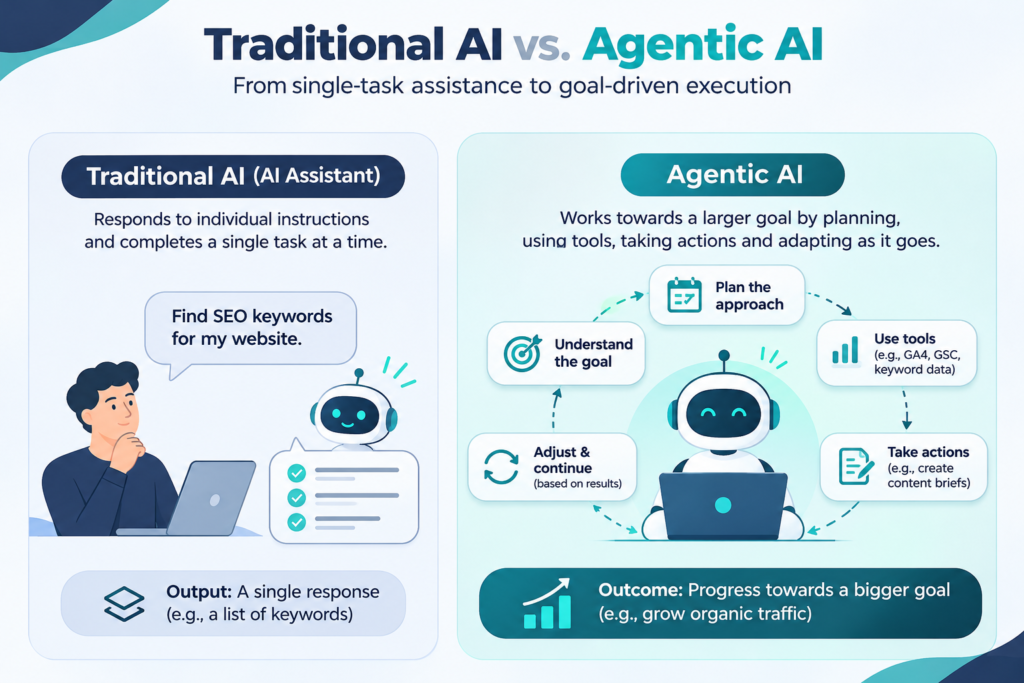
To understand why Gemini 4 Carbon matters beyond software engineering, it helps to understand the difference between an AI assistant and an AI agent.
An AI assistant generally helps with a specific instruction. You provide a prompt, receive an answer and decide what happens next.
An agentic system is designed to work through a sequence of actions to achieve a defined objective. Depending on its tools, permissions and configuration, it may gather information, use external systems, evaluate results and continue with subsequent steps.
Consider a simple example.
You ask an AI assistant: “Analyze these keywords and suggest five article topics.“
It produces a list. You review the suggestions and decide what to do next.
Now imagine a more connected workflow:
You give an AI system a broader objective: “Identify content opportunities for our website in the US market.”
A suitably configured agentic workflow could potentially:
- Examine existing website content.
- Analyse relevant search and competitor information.
- Identify gaps in the existing content.
- Suggest topics based on search intent and business relevance.
- Prepare content briefs for human review.
- Monitor the performance of approved content.
The distinction is not that an AI agent is automatically smarter than an assistant. It is that the system is designed to coordinate several activities towards a larger objective. This is the direction marketers should understand.
What does industry research say about Gemini 4 Carbon?
This is not simply a prediction based on Google’s announcement. Major consulting and research organisations have already been examining the transition towards agentic marketing.
McKinsey: Reinventing marketing workflows with agentic AI
In its April 2026 research, McKinsey discussed how agentic AI could support activities such as content generation, synthetic audience testing and audience-based media planning.
It estimated that agentic AI could eventually power a substantial share of current marketing activities.
McKinsey also highlighted the importance of human capabilities such as quality monitoring, data fluency, collaboration with agents and refining AI-generated ideas using human expertise.
BCG: Agentic AI and the changing marketing operating model
BCG’s July 2026 research, Agentic AI Will Make the CMO’s Role More Consequential, examined how AI agents could influence customer discovery, product evaluation and purchasing decisions.
It also discussed the need for marketing organisations to rethink how they manage customer intelligence, brand experience and marketing operations.
One of its central arguments is that businesses will need to redesign how marketing work is organised rather than simply introduce more AI tools.
Gartner: Why marketing workflows need to change
In its October 2026 research, Prepare Marketing Workflows for Human-AI Transformation, Gartner highlighted an important problem.
Adopting AI at an individual or departmental level can improve productivity without necessarily improving overall marketing performance.
Gartner recommends redesigning important workflows, clarifying responsibilities, fixing broken handoffs and establishing decision-making authority before assigning more work to AI.
The common message across these sources is clear: AI adoption alone is not enough. Businesses need to rethink how work gets done.
3. What Should Marketers Watch Out For in AI development?
The development of more capable AI systems also introduces challenges. Greater autonomy does not automatically mean greater reliability. Here are five areas marketers should monitor.
AI capability versus actual business readiness
A company may have access to advanced AI models but still lack the systems needed to use them effectively. For example, an AI agent analysing campaign performance may need access to advertising data, website analytics, CRM information and conversion records. This does not mean that utilizing Gemini 4 Carbon for business will be ineffective.
If that information is incomplete, disconnected or inaccurate, its recommendations may also be unreliable. Businesses need to assess their data quality, integrations, processes and internal capabilities before introducing more complex automation.
Human oversight and accountability
Imagine an AI system preparing changes to a Google Ads campaign.
It might recommend adjusting budgets, changing targeting or pausing certain keywords.
Even if the analysis is useful, someone needs to evaluate the commercial consequences.
The same applies to website changes, customer communication and email campaigns.
Marketing teams should establish clear boundaries:
- Which actions can AI perform independently?
- Which actions require approval?
- Which information can the system access?
- Who is responsible for reviewing the output?
- How can mistakes be identified and reversed?
This becomes increasingly important as AI systems gain access to business applications.
Data privacy and cybersecurity
More connected workflows can mean more access to business information.
Marketing teams often handle customer records, email databases, advertising accounts, website administration and CRM information.
Giving an AI system unrestricted access to these resources creates unnecessary risk.
Carbon’s cybersecurity capabilities are particularly relevant to the broader discussion, but Google’s reported security benchmark results should not be treated as a guarantee that every AI workflow is safe.
Businesses should use limited permissions, secure integrations, approval requirements and appropriate monitoring.
Productivity should not be confused with growth
Suppose a marketing team previously produced four articles per month and now produces twenty using AI.
Has the business grown?
Not necessarily.
More content does not automatically mean more qualified traffic, enquiries or revenue.
The same applies to advertising campaigns, social media posts and automated email sequences.
Businesses should measure whether AI improves meaningful outcomes, such as:
- Qualified leads.
- Conversion rates.
- Customer acquisition costs.
- Campaign profitability.
- Time required to complete work.
- Revenue contribution.
We explored this distinction in more detail in our article on AI adoption in business and why it doesn’t automatically mean growth. Don’t assume the highest-ranked model is the best for every task.
Carbon’s Artificial Analysis Intelligence Index result is impressive.
However, benchmark rankings do not establish which model will be most useful for a particular marketing workflow.
A marketer should evaluate models against real tasks.
Can the system interpret the company’s data correctly? Does it produce reliable research? Can it follow brand guidelines? Does it respect permissions? Can its output be checked?
The most capable model on a general benchmark may not be the most appropriate or economical choice for every business requirement.
Step by Step Guide on How Growth Hungry Marketers Adapted to Agentic AI?
We talked to several growth marketers, the early adopters of Agentic AI in marketing, to understand this in detail and here’s what we learnt that’ll help you. You don’t need to abandon existing marketing practices or start collecting every new AI tool. Instead, early bird and existing marketers should develop the skills and processes required to work effectively with increasingly capable AI systems.
If you are starting today, here’s a critical roadmap that needs your attention:
Step 1: Understand your existing marketing workflows
Before automating anything, understand how the work is currently performed.
Take an SEO content workflow as an example:
- Identify a topic.
- Research search intent.
- Analyse competitors.
- Prepare a content brief.
- Create the article.
- Review facts and quality.
- Publish the content.
- Monitor organic performance.
Document the process, the tools involved, the people responsible and the decisions made at each stage. You cannot redesign a workflow effectively if you do not understand it first.
Step 2: Learn to define objectives rather than simply write prompts
There is a difference between asking AI to complete a task and defining an outcome.
Instead of: “Write an SEO article about email marketing.”
A more useful instruction might be: “Research the US market for small-business email marketing. Identify three relevant audience problems, analyse the search intent, prepare a content brief and recommend a structure. Use credible sources, distinguish verified information from assumptions and do not publish anything without approval.”
The second instruction provides an objective, context, constraints and expected deliverables. As AI systems become more capable, the ability to define a task properly becomes increasingly important.
Step 3: Develop data literacy
AI recommendations are only as useful as the information behind them. Marketers should become comfortable working with:
- Google Analytics 4.
- Google Search Console.
- Google Tag Manager.
- Advertising platform data.
- CRM reports.
- Conversion and lead-quality information.
Learn how to interpret the numbers rather than simply generate reports.
For instance, if organic traffic increases by 30% but enquiries remain unchanged, the important question is not how to celebrate the traffic increase. It is why the additional visitors are not converting.
Step 4: Learn to supervise and evaluate AI output
A capable AI system can still make incorrect assumptions, misunderstand business requirements or produce inaccurate information. Marketers need to develop the ability to:
- Verify factual claims.
- Check sources.
- Identify unsupported conclusions.
- Evaluate recommendations against business objectives.
- Review changes before implementation.
- Measure the outcome after execution.
Human oversight should be part of the workflow, not something added after a mistake occurs.
Step 5: Experiment with small, measurable workflows
Do not start by automating an entire marketing department.
Choose one repetitive process and test whether AI can improve it.
For example: Experiment: SEO content research
- Existing process: Measure how long a marketer takes to research a topic and prepare a content brief.
- AI-assisted process: Use an AI system to collect information, analyse search intent and prepare a first draft of the brief.
- Human review: Check source quality, search intent and strategic relevance.
- Measurement: Compare preparation time, accuracy and usefulness.
If the new process saves time without reducing quality, expand the experiment.
If it creates additional corrections or unreliable recommendations, improve the workflow before scaling it.
The objective is not to automate for the sake of automation. It is to improve the way marketing work is performed.
Five Skills Marketers Should Develop to Stay Ahead
The development of agentic AI makes certain professional skills increasingly relevant.
| Skill | Why it matters | How to develop it |
| Business understanding | AI needs context to produce commercially relevant recommendations | Study customers, competitors, products and business objectives |
| Data literacy | Marketing decisions need evidence, not just AI-generated explanations | Practise with GA4, GSC, CRM and campaign data |
| Workflow design | Connected tasks need clear processes and responsibilities | Map existing marketing activities and identify bottlenecks |
| AI fluency | Marketers need to understand how to work with and supervise AI systems | Experiment with real marketing problems and evaluate outputs |
| Strategic judgment | Someone must decide which opportunities are worth pursuing | Document decisions, trade-offs, risks and business outcomes |
Many experienced marketers already use some of them. What changes is their importance when more execution can potentially be delegated to AI. We discussed a related development in our article on the GPT-6 Astra impact on marketing and what marketers should learn now. The takeaway is simple: don’t learn AI only to produce more output. Learn how to use it to solve better problems.
Is Gemini 4 Carbon Available to Marketers Yet?
Not generally. At the time of Google’s October 28 announcement, Carbon was initially being made available to a selected group of cybersecurity defenders through Google’s Fairwind programme. Google said it would gradually expand access to trusted partners while continuing to test and improve its safeguards.
The company also said it planned to make the model available to developers, businesses and consumers through its product surfaces. However, a general public release date had not been announced in the original announcement.
This means marketers should not plan around Carbon as an immediately available marketing solution. Instead, they can begin preparing by learning about agentic AI in marketing, improving their existing workflows and experimenting with currently available AI systems.
For the latest availability information, refer to Google’s official Gemini 4 Carbon announcement.
Final Thoughts
The Next Advantage May Belong to Marketers Who Know How to Direct AI. Gemini 4 Carbon is primarily an engineering and cybersecurity development. Its announcement should not be mistaken for proof that AI can already manage complete marketing operations.
But it highlights a direction worth paying attention to.
AI systems are increasingly being developed to handle longer tasks, work across multiple stages and operate with greater autonomy. Meanwhile, research from McKinsey, BCG and Gartner shows that marketing organisations are already exploring how to adapt their workflows to this changing environment.
For marketers, the opportunity is not simply to become better at using another AI tool.
It is to understand how work can be organised when AI becomes an increasingly capable participant in the process.
The marketers who prepare early will be better positioned to identify which tasks to delegate, which decisions need human expertise and how to measure whether AI is creating genuine business value or is Gemini 4 carbon for business highly effective.
The question worth asking is no longer just, “What can AI do for me?” It is, “How should I redesign my work so that AI helps me achieve better outcomes?”
Frequently Asked Questions
What is Gemini 4 Carbon?
Gemini 4 Carbon is Google’s frontier AI model announced on October 28, 2026. It focuses on advanced coding, cybersecurity, agentic capabilities and complex, long-running engineering tasks.
How is Gemini 4 Carbon different from other AI models?
Google highlights its ability to handle complex, multi-step engineering tasks over extended periods. It also reports improvements in coding, cybersecurity, full-stack web development and multimodal understanding.
Can Gemini 4 Carbon automate digital marketing?
Google has not demonstrated Carbon as a dedicated digital marketing automation platform. Its announced capabilities suggest potential relevance to complex workflows, but marketing applications such as SEO automation and campaign management should be treated as possibilities, not confirmed Gemini 4 Carbon features.
What is agentic AI in marketing?
Agentic AI in marketing refers to AI systems designed to work through multiple connected tasks towards a defined objective. Depending on their tools and permissions, they may assist with research, content preparation, campaign analysis and workflow coordination.
Will AI agents replace digital marketers?
There is no evidence from the Gemini 4 Carbon announcement that marketing jobs will disappear. However, greater automation could change the tasks marketers perform and increase the importance of strategic thinking, business understanding, data interpretation and human oversight.
How can marketers prepare for agentic AI?
Marketers can prepare by understanding their existing workflows, improving data literacy, learning to define clear objectives for AI systems, developing quality-control processes and experimenting with small, measurable automation projects.
Is Gemini 4 Carbon publicly available?
Google initially restricted access to selected cybersecurity defenders through its Fairwind programme. It announced plans to expand access to developers, businesses and consumers, but had not announced a general public release date in its October 28 announcement.