Summary
AI adoption in business is accelerating, but adopting new technology doesn’t automatically lead to business growth. AI can help companies reduce repetitive work, analyze information, create marketing content and improve workflows. However, the value it creates depends on how businesses implement it, measure results and make decisions.
China’s recent AI-stock sell-off offers a timely reminder that expectations about a technology and the financial value businesses ultimately realize are not the same thing. For business owners, agency leaders and marketers, the priority should be understanding where AI creates measurable value, where human expertise remains essential, and how to adapt as the technology evolves.
Is AI Adoption a Necessary Business Strategy ?
- A business owner discovers an AI tool that can create marketing content in minutes.
- An agency realises it can automate parts of its reporting process.
- A marketing manager finds a system that can generate dozens of advertising variations in the time it previously took to create a handful.
The possibilities are exciting.
But what happens next?
- Does the business generate more qualified leads?
- Does the agency improve its margins?
- Does the marketing team make better decisions?
- Does it simply produce more work in less time?
These questions matter because AI adoption in business is not the same as business growth.
AI can expand what a company is capable of doing. Yet the commercial value of those capabilities depends on whether they solve a real problem, fit into existing workflows and improve an outcome that matters.
This distinction has become especially relevant as AI investment continues to attract attention across industries.
1. China’s AI Stock-Market Correction Raises an Important Question
In October 2026, China’s AI and semiconductor stocks experienced a significant sell-off. Reuters reported that the STAR50 index, which includes AI and semiconductor companies, had fallen approximately 40% in less than four months, wiping out around $480 billion in market value.
The report cited concerns including stretched valuations, doubts about future AI demand and potential restrictions affecting Chinese technology suppliers.
Source: Reuters — In China, the AI bubble has already burst
Does this mean AI has failed? No.
A stock-market correction does not establish that the underlying technology is ineffective, nor does it prove that AI adoption will stop. Stock prices reflect expectations about future earnings, risk and demand, as well as the financial conditions affecting investors.
However, the event illustrates an important distinction: believing a technology has enormous potential is different from knowing how much economic value a particular business will capture from it.
The same distinction matters at the company level.
A business might invest in AI for the following –
- because competitors are adopting it,
- because leadership expects substantial cost savings,
- because it fears falling behind.
Those reasons may justify investigation, but they are not sufficient to establish that an investment will succeed.
The better question is not simply whether a business should adopt AI. It is whether the proposed use of AI solves a problem worth solving.
2. AI Capability Is Growing Faster Than Many Businesses’ Ability to Use It Well
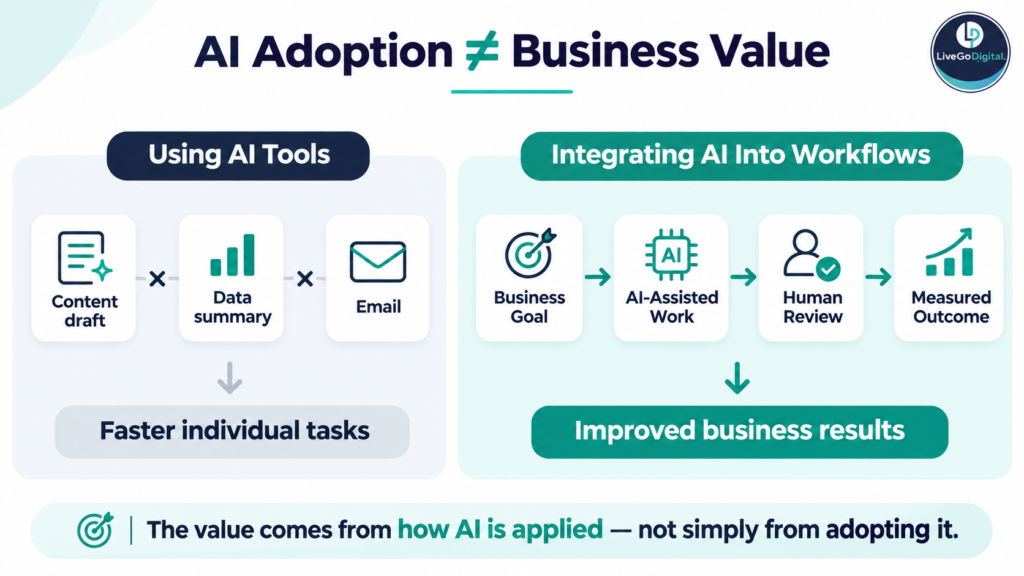
AI systems can now assist with activities that previously required substantial manual effort. Depending on the tool and the workflow, these may include drafting content, analysing reports, organising research, preparing campaign variations and handling parts of multi-step processes.
But capability is only one part of the equation.
In its May 2026 analysis, PwC examined how leading companies generate ROI from AI. Its study of 1,217 organisations found that the top 20% captured 74% of AI-driven returns in the sample.
PwC also reported that stronger performers were more likely to redesign workflows around AI and pursue growth opportunities, rather than simply adding tools to existing processes.
These findings do not mean that every other company is failing. They do suggest that the benefits of AI investment can be unevenly distributed.
Consider two businesses using AI for customer acquisition.
- Business A uses AI to generate more blog posts, advertisements and social media content.
- Business B uses AI to analyse customer questions, identify gaps in its content, test advertising variations and improve how qualified prospects move through its sales funnel.
Both businesses use AI. But they are applying it to different problems.
Business A primarily measures production. Business B is attempting to improve a business process.
The second approach creates a clearer path from AI capability to measurable business value, although its actual results still need to be tested.
3. AI in Marketing
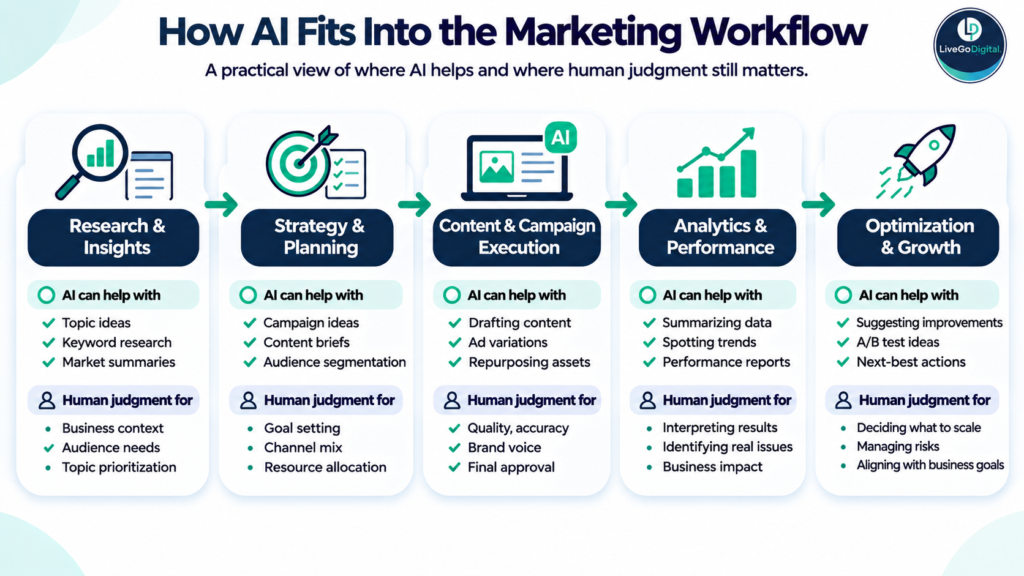
Marketing is one of the clearest examples of the difference between increasing output and improving outcomes.
AI can help marketers create more content, explore more ideas, analyse more information and perform certain repetitive tasks faster. These are useful capabilities, especially for small businesses and agencies working with limited resources.
However, marketing success depends on more than the amount of work produced.
A blog post can be grammatically excellent but target the wrong search intent. An advertisement can attract clicks without generating qualified enquiries. A social media campaign can generate engagement without contributing meaningfully to sales.
AI can help improve these activities, but using it does not automatically resolve the underlying business problem.
Example: More content, but no additional leads
Imagine a small business uses AI to double its monthly blog output.
After three months, it has published substantially more articles. Yet qualified organic traffic and enquiries remain unchanged.
Should the business produce even more content? Not necessarily.
The underlying problem could involve keyword selection, search intent, weak differentiation, an unclear service offering or a landing page that fails to convert visitors.
Generating additional articles may increase production without addressing any of those issues.
The business needs to investigate why its content isn’t contributing to its goals before deciding whether more automation will help.
This is also why the ability to generate content should not be confused with the ability to earn visibility. In our guide, Can AI Content Rank on Google?, we explore the distinction between AI-generated content and the factors that determine whether content performs in search.
The lesson for business owners: Use AI to improve the marketing process, not simply to increase the volume of marketing activity.
4. Cutting Costs isn’t Real Growth
One attraction of AI is the possibility of reducing the time and effort required to complete certain tasks. In some cases, automation may also reduce operating costs.
But business owners should distinguish between three outcomes:
- Efficiency: A task takes less time or costs less to complete.
- Capacity: The team can accomplish more with its available resources.
- Growth: The business improves outcomes such as revenue, customer acquisition, retention or profitability.
These outcomes can be connected, but they are not interchangeable.
For example, an agency might automate parts of its reporting process and save ten hours each month. That is a genuine efficiency gain.
If the agency uses the recovered time to improve client strategy, strengthen reporting quality or serve additional clients profitably, the efficiency gain may contribute to growth.
If the time is saved but the agency’s workflow, client outcomes and capacity remain unchanged, the financial impact may be more limited.
The same principle applies to headcount decisions.
AI may reduce the human effort required for particular tasks. But deciding that an entire role is unnecessary requires a broader assessment of responsibilities, quality, oversight, workload and business needs.
Removing people simply because a tool can perform part of their work risks overlooking the judgment, coordination and accountability those people provide.
AI can change the cost of doing work. It does not automatically determine how a business should organise its people.
5. AI Can “Not” Replace Employees
Businesses do not need to choose between using AI for everything and avoiding it entirely. A more useful approach is to distinguish between tasks AI can assist with and decisions that require meaningful human oversight.
| Area | Where AI can help | What still needs attention |
|---|---|---|
| Content marketing | Drafts, outlines, research organisation and repurposing | Accuracy, originality, audience relevance and editorial judgment |
| SEO | Keyword clustering, data summaries and content-gap exploration | Search intent, prioritization and business relevance |
| Advertising | Generating creative variations and summarizing performance | Budget allocation, audience fit and campaign decisions |
| Analytics | Explaining patterns and summarizing reports | Data quality, attribution and interpreting the business implications |
| Client service | Drafting communications and organising meeting notes | Relationships, negotiation, accountability and trust |
| Strategy | Exploring options and identifying potential trade-offs | Choosing priorities and accepting responsibility for decisions |
The capabilities of AI tools vary, and some systems can now execute more complex workflows than others. The important point is that a tool’s ability to produce an answer or complete a task does not guarantee that its output is appropriate for a particular business.
For a deeper discussion of these distinctions, see our article on whether AI can replace a marketing team.
The role of marketers is changing
As AI makes some execution tasks faster, marketers need to develop skills that help them direct, evaluate and improve that work.
Five areas deserve particular attention:
1. Business understanding
Marketers need to understand the company’s customers, positioning, commercial goals and competitive environment. Without this context, even a technically strong AI output may solve the wrong problem.
2. Data literacy
Understanding analytics, conversion rates, customer acquisition costs and campaign performance helps marketers distinguish useful activity from measurable progress.
3. Systems thinking
Marketing results often depend on connected processes: advertising, landing pages, tracking, lead management and sales follow-up. Optimising one task in isolation may not improve the entire system.
4. AI fluency
Marketers should learn how to assign tasks to AI, provide relevant context, evaluate outputs and recognise when a tool is unreliable or unsuitable for a particular job.
5. Judgment and accountability
Someone still needs to decide what to prioritise, which recommendations to reject, what risks are acceptable and whether the outcome serves the business.
These skills are not a guarantee against job changes. They are practical ways for marketers to remain useful as tools and workflows evolve.
A Practical Framework Before Investing in AI
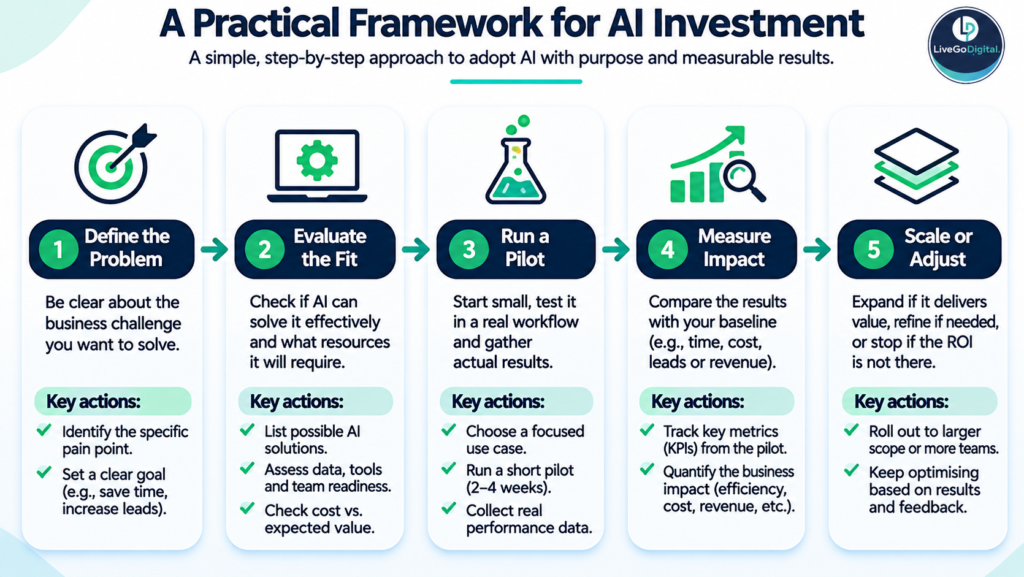
Before purchasing another AI tool or expanding an existing implementation, business and agency owners can ask five questions.
Question 1: What specific problem are we solving?
Avoid adopting a tool simply because it is popular or competitors are using it.
Identify the actual problem first. Is it slow reporting, expensive content production, inconsistent lead follow-up, poor campaign analysis or something else?
If the problem is unclear, the business will struggle to evaluate whether the tool has helped.
Question 2: What is the total cost?
The subscription fee is only one part of the investment.
Consider implementation, integration, training, data preparation, human review, error correction and ongoing maintenance. A tool that appears inexpensive may require substantial additional work to produce reliable results.
Question 3: What baseline will we compare against?
Record the current performance before introducing the new workflow.
Depending on the task, this could include time spent, cost per deliverable, error rates, qualified leads, conversion rates or customer satisfaction.
Without a baseline, it becomes difficult to determine whether the change actually improved performance.
Question 4: What does success look like?
Choose a measurable outcome that connects to the original problem.
For a content workflow, that might be reduced production time while maintaining quality. For advertising, it might be improved cost per qualified lead. For reporting, it might be faster delivery without sacrificing accuracy.
The appropriate metric depends on the objective. More output alone is rarely sufficient.
Question 5: Should we expand, adjust or stop?
Test the workflow on a manageable scale, review the results and decide what to do next.
If it delivers reliable value, consider expanding it. If results are mixed, identify the bottleneck. If the total cost or risk outweighs the benefit, reconsider the approach.
This creates a more disciplined approach to AI adoption than assuming every new capability deserves an immediate investment.
The Secret Strategy to Adapt AI for Businesses
AI is evolving quickly, and business owners may feel pressure to adopt every new model, automation platform or agent.
But continuously switching tools can create its own costs: disrupted workflows, duplicated subscriptions, repeated training and a lack of consistent measurement.
A more sustainable approach is to focus on the work rather than the novelty of the technology.
Start with a small number of meaningful use cases. Establish clear review standards. Train employees to use AI responsibly. Protect confidential customer and business information, and check the data-handling terms and settings of each tool before sharing sensitive information.
Review performance periodically and expand only when there is evidence that the workflow is useful.
For marketers, adapting also means keeping up with changes in how customers discover information. AI is becoming part of search and information discovery, so understanding how to create useful, trustworthy content remains important. Our guide to getting cited in Google AI Overviews explores that related challenge.
The objective is not to become an expert in every new AI tool. It is to become better at identifying problems, selecting appropriate tools and making informed decisions about the results.
Adopting AI With a Purpose
AI can create real value for businesses. It can help teams work more efficiently, expand their capabilities and explore opportunities that were previously too expensive or time-consuming.
But the technology does not eliminate the need for business judgment.
China’s AI-stock correction is a reminder that expectations and financial outcomes can diverge. For individual businesses, the equivalent mistake is assuming that adopting AI, increasing output or reducing headcount automatically creates growth.
The better approach is to identify the problem, understand the capabilities and limitations of the technology, measure the results and remain willing to change course.
AI adoption is a starting point, not proof of success. What matters is whether it helps your business serve customers better, operate more effectively and create measurable value.
Frequently Asked Questions
What does AI adoption in business mean?
AI adoption in business means integrating artificial intelligence into business activities, such as customer service, marketing, analytics, operations or decision support. The level of adoption can range from using an AI assistant for individual tasks to embedding AI into connected workflows.
Does AI adoption automatically lead to business growth?
No. AI may improve efficiency or expand a company’s capabilities, but growth depends on whether those improvements translate into outcomes such as increased revenue, better customer retention or improved profitability.
Can AI replace employees to reduce business costs?
AI can automate some tasks and reduce the human effort required to perform them. Whether a role can be reduced or redesigned depends on the responsibilities involved, the reliability of the workflow, the need for human oversight and the wider business impact.
How can a business measure AI ROI?
A business should compare the total cost of an AI implementation with the financial or operational benefits it generates. Depending on the use case, relevant measures may include time saved, reduced operating costs, improved conversion rates, revenue gains or fewer errors.
How should marketers adapt to AI?
Marketers should develop AI fluency alongside business understanding, data literacy, systems thinking and judgment. They should learn to direct AI effectively, verify its outputs and connect marketing activities to measurable business objectives.
Should small businesses invest in AI now?
Small businesses should evaluate AI based on their needs, budget and readiness. Starting with a specific, low-risk use case and measuring the results is generally more informative than adopting multiple tools without a clear purpose.