Summary:
The GPT-6 Astra impact on marketing is becoming clearer as AI moves further into complex professional work, while already changing how marketers perform their jobs. OpenAI’s analysis of more than 1.5 million work-related ChatGPT messages found that workers are increasingly using AI for tasks outside their usual occupations, with some becoming recurring parts of their workflows.
For marketers, the bigger question isn’t simply whether AI can do more tasks. It’s which skills become more valuable when AI can handle more of the execution.
Every time a more capable AI model launches, marketers tend to ask the same question:
“What does this mean for my job?”
It’s a reasonable question.
AI can already help marketers research, write, analyze data, generate creative variations, automate repetitive work and support campaign decisions. Now, systems are becoming capable of going beyond individual tasks.
OpenAI describes GPT-6 Astra as state-of-the-art in computer use, browsing, software engineering and professional work, with the ability to handle demanding multi-step tasks.
That matters to marketers because marketing itself is increasingly becoming a collection of connected workflows.
Research leads to content > Content leads to campaigns > Campaigns generate data > Data influences decisions > and AI is gradually moving into more of those steps.
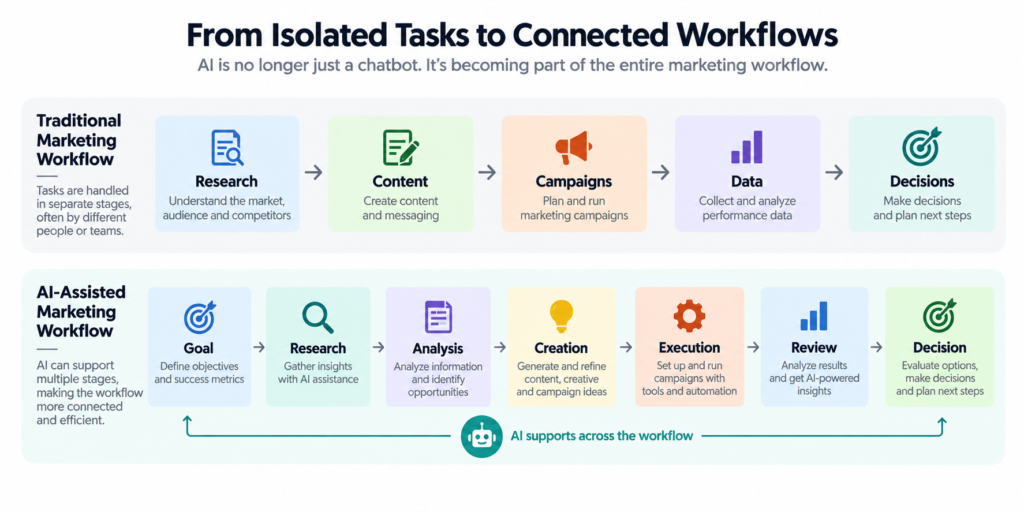
But instead of asking:“Will AI replace marketers?” there’s a more useful question: “If AI can do more of the execution, what should marketers become better at?”
That’s where the real GPT-6 Astra impact on marketing becomes interesting.
The Real Impact of AI on Marketing
1. More marketing execution can be automated
Some marketing tasks are relatively structured. For example:
- Creating content variations
- Writing initial ad copy
- Summarizing reports
- Researching competitors
- Repurposing content
- Generating creative concepts
- Analyzing large amounts of information
- Preparing campaign variations
AI can increasingly handle parts of these activities. That doesn’t automatically mean the marketer disappears.It means the amount of human effort required to produce the output can change. AI-generated content is one of the clearest examples of this shift. But generating content and earning visibility from it aren’t necessarily the same thing. We looked at whether 100% AI content ranks on Google in a separate guide.
Also, when execution becomes cheaper and faster, the value of simply being able to execute also changes. Imagine an AI system generating 50 ad variations in minutes.
The marketer’s challenge is no longer: “Can I create enough variations?”
It’s: “Which variations should we actually use?”
That is a very different skill.
2. AI is moving from an assistant to part of the workflow
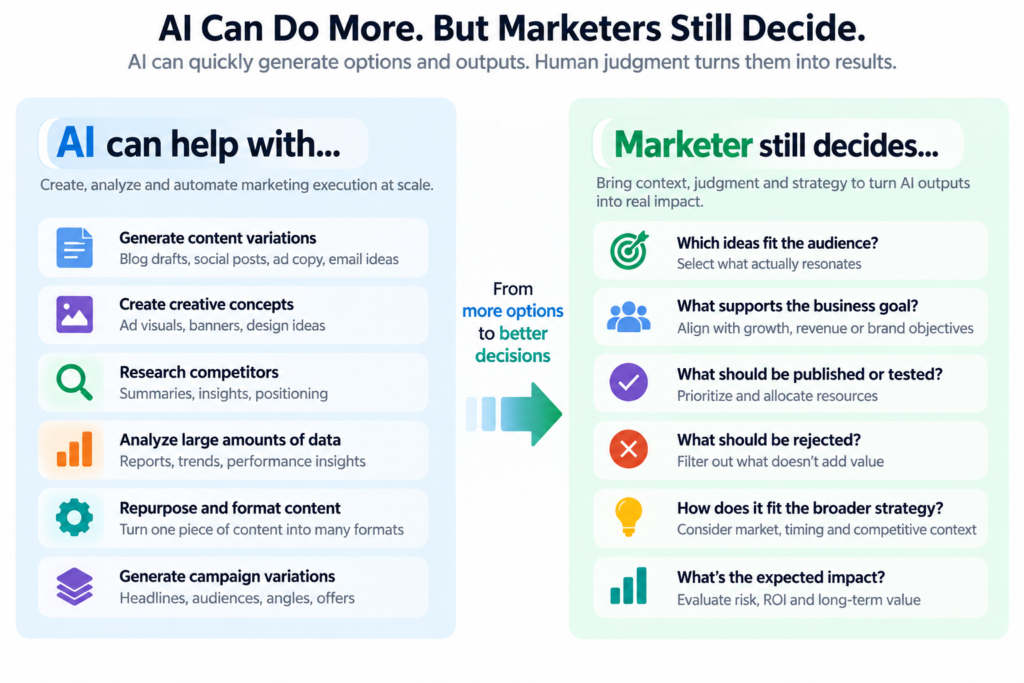
For years, a typical AI workflow looked something like:
Marketer > Prompt > AI > Output
But more capable AI systems are moving toward something closer to:
Goal > Research > Analysis > Creation > Execution > Review
GPT-6 Astra is designed for complex computer and browser use and professional tasks rather than only generating text in a conversation. That distinction is important.
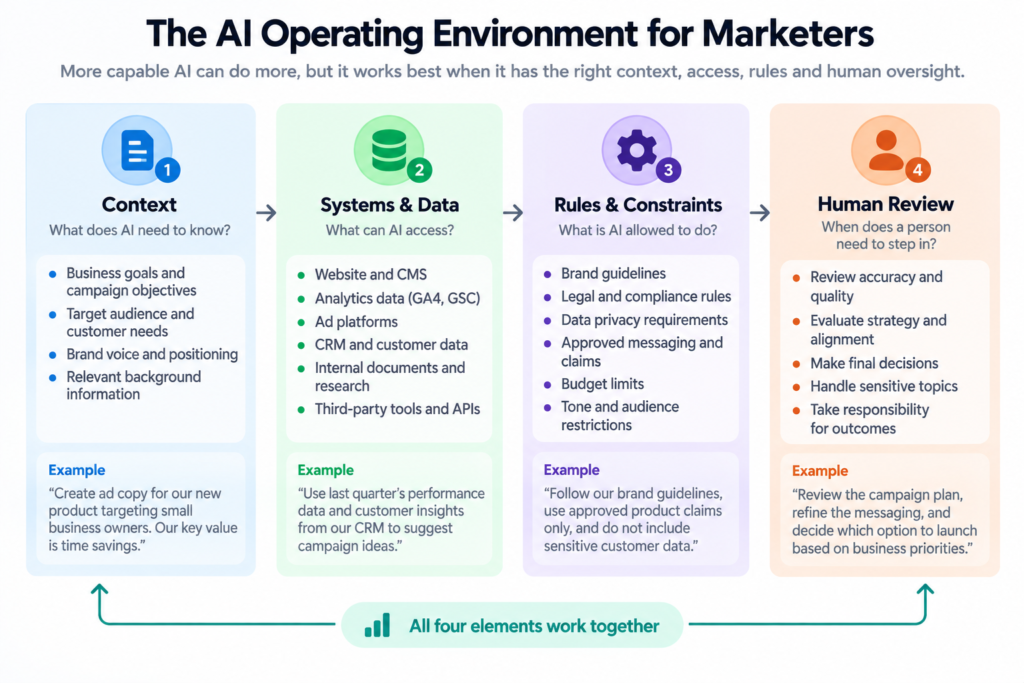
The more capable AI becomes, the more important its operating environment becomes — the context it receives, the systems it can access, the rules it operates under and the points where a human needs to step in.
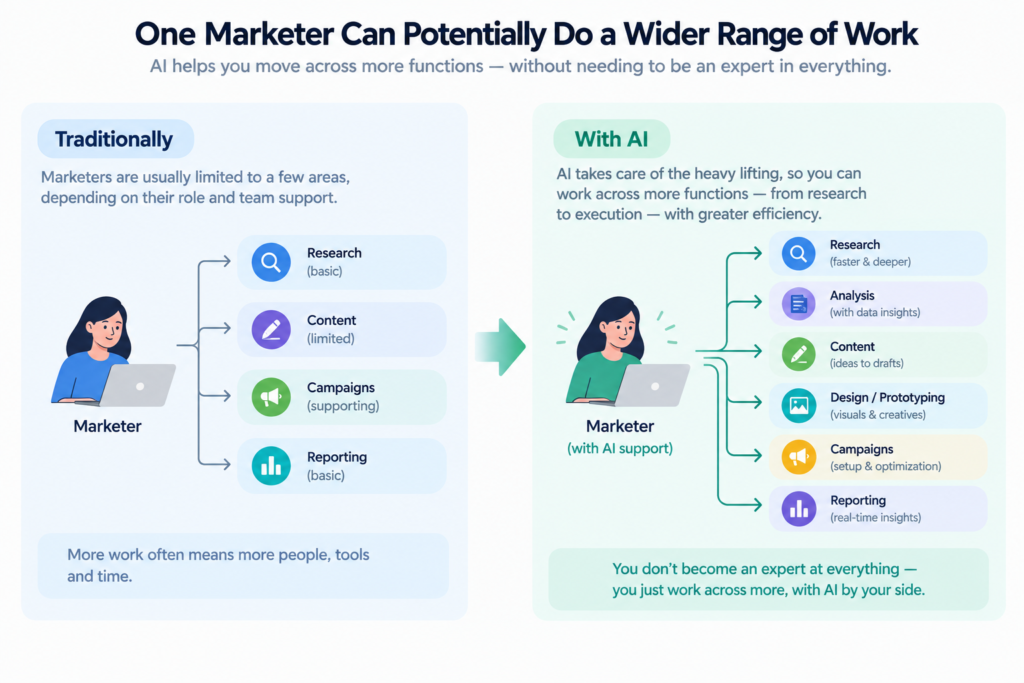
3. One marketer can potentially do a wider range of work
Marketing has always depended on other functions. A marketer may need help from:
- Designers
- Developers
- Analysts
- Researchers
- Copywriters
AI can increasingly help marketers perform parts of these different activities themselves.
OpenAI’s workplace research found evidence that workers are using AI for tasks traditionally associated with other occupations. Among roughly 6,200 workers observed consistently from April through July 2026, previously used cross-occupation tasks increased from 13.1% of occupation-specific AI activity in April to 25.9% in July. (Source: https://openai.com/index/unlocking-new-ways-of-working/ )
This doesn’t mean one marketer suddenly becomes an expert in every function. It means AI can reduce some of the barriers between different types of work.
A marketer may be able to investigate a technical problem, analyze data, create a prototype or prepare an initial design without waiting for another team to handle every first step.
The same expansion is happening in search. As AI becomes part of how people discover information, marketers also need to understand how visibility works beyond traditional search results. Our guide to rank in Google AI Search explores this shift in more detail.
4. Execution may become cheaper. Judgment may become more important.
This is probably the most important shift.
Suppose AI gives you 50 content ideas. Which five deserve resources?
Suppose it generates 20 advertising variations. Which one fits the audience and the business?
Suppose it identifies 3 possible strategies. Which one should the company actually pursue?
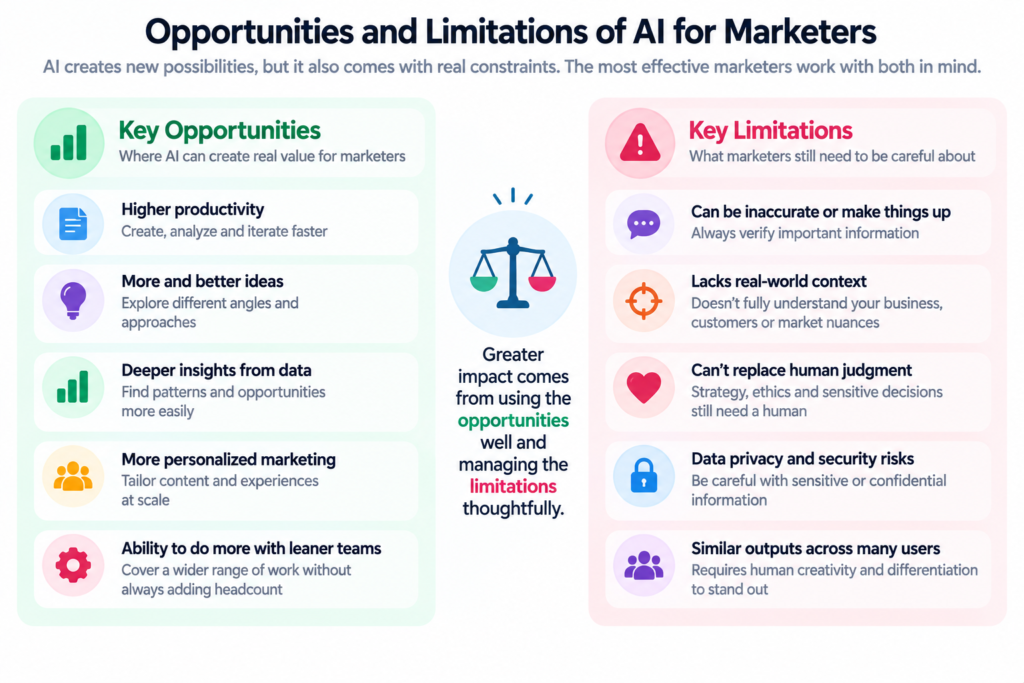
AI can make the number of options larger. The marketer still needs to decide what matters.
And that decision depends on things AI doesn’t automatically know:
- Business priorities
- Customer needs
- Available resources
- Competitive conditions
- Brand positioning
- Risk
- Timing
- Expected business impact
This is why AI doesn’t necessarily make strategic thinking less important. It can make good judgment more important.
How Marketers Can Stay Above the Curve
The answer isn’t to learn every AI tool that launches. There will always be another model, another agent and another platform. Instead, marketers should think about the capabilities that become more valuable because AI is becoming better at execution.
1. Spend Less Time Chasing Every New AI Tool
Every new AI model brings another tool, feature, or prompt technique to learn. But constantly switching between tools doesn’t necessarily make you a better marketer.
Instead of asking “Which AI tool should I learn next?”, start asking “Where can AI actually improve my marketing workflow?”
You don’t need to master every new model. You need to understand which tasks are worth delegating to AI, what the expected outcome should be, and how to evaluate the result.
The goal isn’t to use more AI tools. It’s to use AI more purposefully.
2. Build Stronger Business Context
AI can generate a campaign idea in seconds. But does it understand why your business needs that campaign? Marketers need to understand the bigger picture:
- Who is the customer?
- What problem are they solving?
- What does the business want to achieve?
- What makes the offer different?
- What constraints does the business have?
- What has already been tried?
The more context you can provide, the more useful AI can become.
A marketer who understands the business can tell AI what problem to solve, rather than simply asking it to produce something.
3. Understand Your Data and Systems
AI becomes more useful when it can work with the information surrounding a marketing task.
Think about a simple workflow:
Website > Analytics > Ads > Leads > CRM > Sales
A marketer doesn’t necessarily need to become a developer or data scientist. But understanding how these systems work together can make a significant difference.
Know:
- Where your data comes from
- What each metric actually tells you
- How information moves between systems
- Where tracking can fail
- Which tasks can be automated
- Where human review is needed
The future marketer may need to understand the system behind the campaign, not just the campaign itself.
4. Define Rules and Constraints
Knowing what AI can do isn’t enough. You also need to define what it should do. For example, AI might be able to generate an entire campaign, but that doesn’t mean it should independently decide:
- How much budget to spend
- Which claims a brand should make
- How sensitive customer information is handled
- What communication goes to customers
- Which strategic direction the business should take
Clear rules give AI boundaries.
That means marketers need to become comfortable defining what AI can handle, what requires review, and what should remain human-owned.
5. Strengthen Judgment and Human Oversight
AI can give you options. You still have to choose.
It can generate 50 content ideas, but which five deserve investment?
It can identify several campaign opportunities, but which one actually fits the business?
It can analyze performance data, but what action should the company take?
These decisions require context, prioritization, trade-offs, and judgment.
As AI takes on more execution, marketers may increasingly spend their time evaluating outputs, making decisions, and taking responsibility for outcomes.
The valuable skill isn’t simply knowing what AI can do. It’s knowing when to trust it, when to question it, and when to step in.
Real Example: AI Is Already Entering the Advertising Workflow
The shift isn’t hypothetical.
On September 16, 2026, OpenAI announced new AI-powered advertising experiences that allow businesses to use natural-language prompts to create, update and analyze campaigns. Ads Manager also includes AI creative tools that can suggest copy and imagery based on a landing page and campaign objective.
OpenAI also announced integrations with HubSpot and Shopify, connecting its advertising platform with tools businesses already use.
Look at what this means for a marketer.
Traditional workflow
Brief > Research > Copy > Creative > Campaign setup > Reporting > Analysis
Increasingly AI-assisted workflow
Brief > AI-assisted research/creation > Human review > Campaign > AI-assisted analysis > Human decision
The important part isn’t simply that AI can create an ad. It’s that AI is increasingly becoming involved in multiple stages surrounding the ad. The marketer’s role can therefore shift toward:
- Defining the objective
- Providing business context
- Setting constraints
- Reviewing AI outputs
- Interpreting results
- Deciding what happens next
And that’s a much more interesting change than simply saying: “AI can write ad copy.”
What Should Marketers Actually Learn?
The American Marketing Association’s 2026 State of Marketing Careers Report, based on a survey of 1,412 marketing professionals alongside job-posting data and industry interviews, found that AI fluency is becoming a baseline expectation. Its research also highlights skills such as adaptability, strategic thinking, discernment and decision-making, quality control, business acumen and original thinking. That gives us a useful way to think about the next phase of marketing.
Build these five areas:
1. Business context
Understand customers, markets, positioning and business goals.
2. Data literacy
Understand the information behind marketing decisions.
3. Systems thinking
Understand how channels, technology and business processes connect.
4. AI fluency
Know what AI can do, how to delegate work to it and how to evaluate its output.
5. Judgment
Know how to prioritize, make trade-offs and decide when human involvement is necessary.
The World Economic Forum also points toward a combination of technical and human capabilities: AI and big data are among the fastest-growing skills, while analytical thinking, creative thinking, resilience, flexibility, leadership and social influence remain important.
So the future isn’t necessarily: AI skills vs. human skills.
It may increasingly be: AI capability + human judgment.
How to Actually Build These Skills
You don’t need to learn all five areas through separate courses or certifications. Many of them can be developed by changing how you approach your existing marketing work.
1. Business context:
Start with the business you’re already working on. Read the company’s website, understand its customers, study its competitors and connect your marketing activities to actual business goals.
2. Data literacy:
Go beyond reporting numbers. Use tools such as Google Analytics, Google Search Console and advertising platforms to investigate why something changed, not just what changed.
3. Systems thinking:
Map one of your existing marketing workflows from beginning to end, for example:
ad > landing page > tracking > lead > CRM > sales.
Identify where data moves, where something can break and where AI or automation could help.
4. AI fluency:
Don’t learn AI only by collecting prompts or trying every new tool. Pick a real marketing task and experiment with delegating part of the workflow to AI. Compare the output, check where it fails and refine the process.
5. Judgment:
Practice making decisions, not just producing recommendations. When AI gives you several options, document why you chose one, what trade-offs you considered and what happened afterward.
In other words, learn AI where you actually do marketing: through real problems, real data and real decisions.
Key Takeaways
- AI is moving beyond content generation and into broader, multi-step workflows.
- Marketing execution is becoming easier to automate, but that doesn’t automatically mean marketing jobs disappear.
- Marketers who understand business context, data and systems can use AI more effectively.
- As AI produces more options and outputs, judgment, prioritization and accountability become increasingly important.
- The goal isn’t to compete with AI at everything it can do. It’s to become better at understanding, directing, evaluating and deciding.