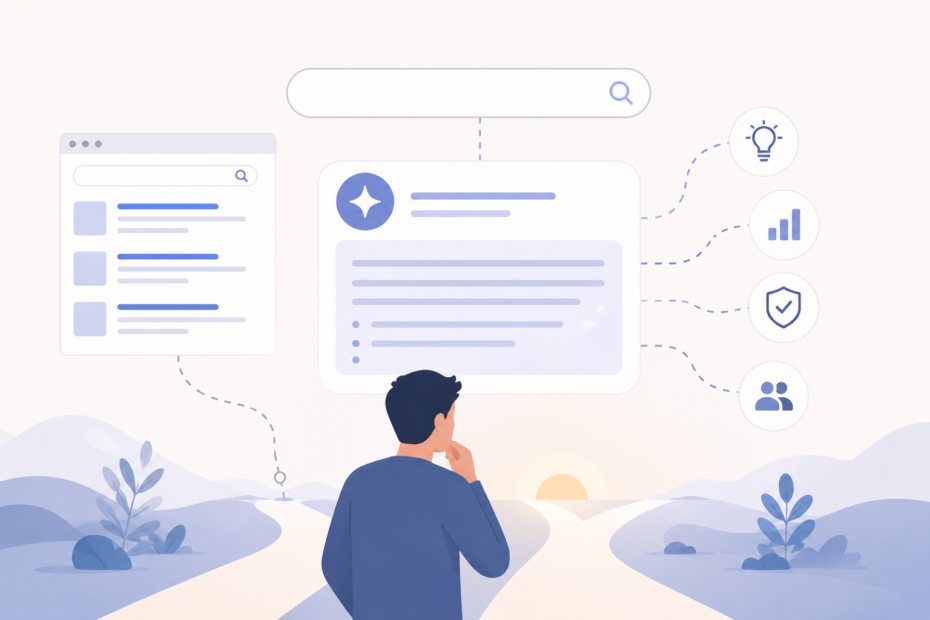
If someone asks me what SEO in 2027 will look like, I don’t think the conversation should start with rankings, backlinks, or even traffic. I think it should start with people because search has always been about helping users find answers, and the way people look for those answers is changing faster than ever before. The biggest shift in SEO in 2027 may not be a Google update or a new ranking factor. It may simply be the fact that users increasingly prefer answers over links.
But now the habit is changing.
People do not always want to search anymore. They want to ask. They want to explain the full problem in their own words. They want the answer to appear instantly, in a way that feels clear, direct, and useful.
That is why AI tools such as ChatGPT, Claude, Gemini, Perplexity, and Google AI Overviews are becoming important. They are not just new tools. They are changing user expectations.
The data already shows this shift. Pew Research found that when Google users saw an AI summary, they clicked a traditional search result in only 8% of visits, compared with 15% when no AI summary appeared. Users also clicked links inside the AI summary in only 1% of visits. This shows that AI answers are already reducing the need to click through to websites for some searches.
Adobe also reported that traffic from generative AI sources to U.S. retail websites increased by 1,200% in February 2025 compared with July 2024. For travel, leisure, and hospitality websites, Adobe reported a 1,700% increase in traffic from generative AI sources during the same period.
These numbers matter because they show one clear thing. People are not only searching differently. They are trusting different interfaces to begin their research.
My First Realization: People Want Answers, Not Just Results
The first time I tried ChatGPT, it felt different from Google because it did not behave like a search engine. It behaved as if it understood what I was asking and tried to respond directly.
That experience changed how I started thinking about search.
With Google, even when the results are good, the user still has to do the work. You open pages, read introductions, skip irrelevant paragraphs, compare answers, and then decide what is useful. With AI tools, the experience feels more direct because the answer is already shaped for the user.
This does not mean AI is always correct. ChatGPT can make mistakes. AI Overviews can also be incomplete. But the experience is powerful because it matches what people emotionally want from search: less effort, less confusion, and faster clarity.
That is why I do not think the future of SEO should only be discussed in terms of rankings. In 2027, the bigger question will be how people discover, trust, and act on information.
Why Traditional Search Sometimes Feels Slow
Google is still one of the most powerful discovery systems in the world, but traditional search has one weakness. It often gives users sources before it gives them answers.
If someone searches for a website issue, a health question, a product comparison, or a simple how-to guide, they may not want five websites. They may want one useful answer that actually solves the problem.
This is where AI feels different.
Earlier, people had to reduce their thoughts into short keywords because that was how search worked. A user might search “website speed issue” or “best cardio exercise.” But the real problem in their mind is usually much more specific.
They may actually mean:
“My website is loading slowly on mobile, but only on product pages. What should I check first?”
Or:
“I have only 10 minutes, dumbbells, and resistance bands. What workout can I do at home?”
Traditional search can answer these questions, but AI can often respond faster because the user can explain the whole context in one place.
That is the behavioral change SEO professionals need to understand.
If users are increasingly looking for direct answers instead of browsing multiple websites, then the way content is structured also needs to evolve. Discover how to create content that is easier for AI systems to understand, reference, and surface in search experiences.
Why Informational Content Will Be Hit First
Informational content is the most exposed category because many informational queries are answer-based. If the answer can be summarized, AI can reduce the need for a website visit.
For example, if someone wants to know what a term means, how to perform a basic task, how to compare two concepts, or how to troubleshoot a common issue, AI can usually provide a fast response.
This does not mean all informational websites will disappear. It means generic informational content will struggle.
The content that simply repeats what hundreds of other websites already say will become less valuable. But content based on original research, expert experience, real testing, case studies, unique data, and strong opinions will still matter because AI systems need reliable sources to learn from, cite, and reference.
So the real problem is not information content itself. The real problem is generic information content.
Why Service Businesses Are Different
Service businesses will not be affected in the same way as basic informational websites because hiring a service provider requires trust.
If I need a dentist, surgeon, plumber, lawyer, roofer, mover, or AC repair company, I will not hire someone only because AI recommended them. I may use AI to create a shortlist, but I will still check reviews, location, experience, pricing, credentials, and proof of work.
This is where local SEO, Google Business Profiles, reviews, service pages, case studies, and reputation still matter.
AI can recommend a business, but a recommendation isn’t the same as a conversion.
A user may discover a business through AI, but they still need confidence before taking action. That confidence usually comes from human proof: reviews, photos, testimonials, credentials, before-and-after work, pricing transparency, and real customer experience.
This is why service businesses should not panic. They should evolve.
Why Reviews and Brand Trust Will Matter More
People trust people more than marketing claims.
A business can say it is the best, but users want proof. Reviews help users understand whether real customers were satisfied. Testimonials show whether the business actually solved problems. Case studies show process and results.
This will become even more important in an AI-driven search environment because AI may introduce a brand to users, but trust will still decide whether users choose that brand.
For expensive products, people will still check reviews. For important services, people will still compare providers. For health, legal, finance, and home service decisions, users will still want reassurance.
That is why brand trust may become more valuable than traffic alone.
In the old SEO model, many businesses focused mainly on ranking. In the new model, ranking is only one layer. The bigger goal is to become the brand users recognize, remember, and verify.
Why AI Recommendations Do Not Automatically Create Customers
There is a big difference between being mentioned and being chosen.
If AI recommends three laptops, the user still has to choose one. They may check YouTube reviews, Reddit discussions, Amazon ratings, comparison videos, and expert reviews before buying.
The same thing happens with services. If AI recommends three dentists or three moving companies, the user will still investigate. They may read Google reviews, visit the website, compare pricing, call the business, and assess whether the company feels trustworthy.
This is why AI visibility should not be treated as the final goal.
The final goal is still trust.
AI can create awareness. Reviews create confidence. Experience creates conversion.
The Visibility Pyramid for 2027
The future of SEO will not be based on one single factor. It will be layered.
At the foundation, technical SEO still matters because search engines and AI systems need to crawl, understand, and interpret websites correctly. If a website has poor structure, missing schema, weak internal linking, or confusing page architecture, it becomes harder for both Google and AI systems to understand the business.
The second layer is content quality. Content must answer real questions, not just target keywords. It should solve problems quickly, explain clearly, and include examples that reflect actual user situations.
The third layer is authority. In industries like health, law, finance, and education, authority will matter even more because users need expert-backed answers.
The fourth layer is brand recognition. If users already know a brand, they are more likely to trust it when it appears in search, AI Overviews, ChatGPT answers, or comparison results.
The top layer is AI recommendation visibility. This means being present in the sources, discussions, reviews, mentions, and knowledge ecosystems that AI tools may use to form recommendations.
What I Think Will Happen by 2027
By 2027, I think users will expect faster answers by default. They will not always want to scroll through websites unless the decision requires trust, proof, or comparison.
Informational websites with generic content may lose traffic because AI can answer many simple questions directly. At the same time, websites with original research, strong expertise, real-world experience, and unique insights may become more valuable because they provide information AI cannot easily invent.
Service businesses will still depend on reviews, local visibility, trust signals, and brand reputation. A roofing company, dental clinic, law firm, moving company, or medical practice will still need strong service pages, Google Business Profile optimization, reviews, photos, FAQs, and proof of expertise.
E-commerce businesses will also need more than just AI visibility, as users still compare prices, reviews, delivery options, product quality, and real customer feedback before buying.
The biggest shift is that traffic may no longer be the only measure of success. A brand may receive fewer clicks but more recognition. A business may be mentioned in AI-generated answers, searched for later, and selected after the user verifies the reviews.
That means SEO reporting will need to change as well.
What Businesses Should Do Now
Businesses should stop creating content only for rankings and start creating content for trust.
This means answering real customer questions clearly, adding expert insights, using original examples, publishing case studies, improving product pages, collecting better reviews, and showing real proof of work.
They should also build niche authority. In a world where AI can summaries generic information, businesses need to become known for something specific. A general brand may be ignored, but a brand with clear expertise in a narrow problem can become easier to remember and recommend.
The goal should not be to publish more content. The goal should be to publish more useful, more credible, and more experience-driven content.
If a business becomes a source that both users and AI systems trust, it will be more likely to remain visible in 2027.
Key Takeaways
- Users increasingly want direct answers instead of lists of links.
- AI Overviews are already reducing clicks for some searches.
- Generative AI is becoming a real discovery channel for shopping, travel, finance, and information research.
- Informational content will be affected first, especially generic content.
- Service businesses will still rely heavily on reviews, trust, reputation, and local visibility.
- AI recommendations can create awareness, but they do not automatically create customers.
- Brand recognition may become more important as users compare AI recommendations with real-world proof.
- The future of SEO is not only rankings. It is visibility, trust, authority, and usefulness across every search interface.
Conclusion
SEO in 2027 will not be dead, but it will not look the same as the SEO many businesses understand today. The old model was mostly about ranking pages. The new model will be about becoming visible wherever people search, ask, compare, and make decisions.
People will still use Google, but they will also use ChatGPT, Claude, Gemini, Perplexity, Reddit, YouTube, reviews, and AI Overviews. They will move between platforms depending on what they need.
For simple information, they may accept an AI answer. For serious decisions, they will still verify. For services, they will still check reviews. For products, they will still compare experiences. For brands, they will still look for trust. The future of SEO is about being the answer, being the trusted source behind the answer, and being the brand people choose after the answer.