Summary:
Google algorithm update trends from 2022 to May 2026 reveal a clear shift in how Google evaluates websites. Over the last four years, Google has moved away from rewarding keyword-focused content and increasingly prioritizes helpful information, real expertise, topical authority, and user experience.
This guide breaks down the evolution of Google’s major updates from the Helpful Content era to the May 2026 Core Update, explains what changed at each stage, and provides a practical checklist to help businesses and marketers adapt to modern search ranking signals.
Introduction: Why This Timeline Matters
Google doesn’t reset. It evolves.
When you hear that Google “sent you back to square one,” what’s actually happening is that Google is refining what it considers valuable. The rules aren’t changing completely—they’re getting stricter, more sophisticated, and more aligned with what real users actually need. Google itself explains that core updates are broad changes designed to improve how Search assesses content overall rather than targeting specific websites or pages. This is why rankings can shift even when nothing on your website has changed.(Source: Google Search Central – Core Updates Documentation)
Between August 2022 and May 2026, Google released over 30 confirmed major updates. Each one built on the previous, creating a compounding effect that has fundamentally changed how websites rank. Strategies that generated traffic in 2022 are now actively suppressed in 2026.
This guide maps the entire evolution, showing you what changed at each step and why it matters for your rankings today.
The Evolution Timeline: What Changed and When
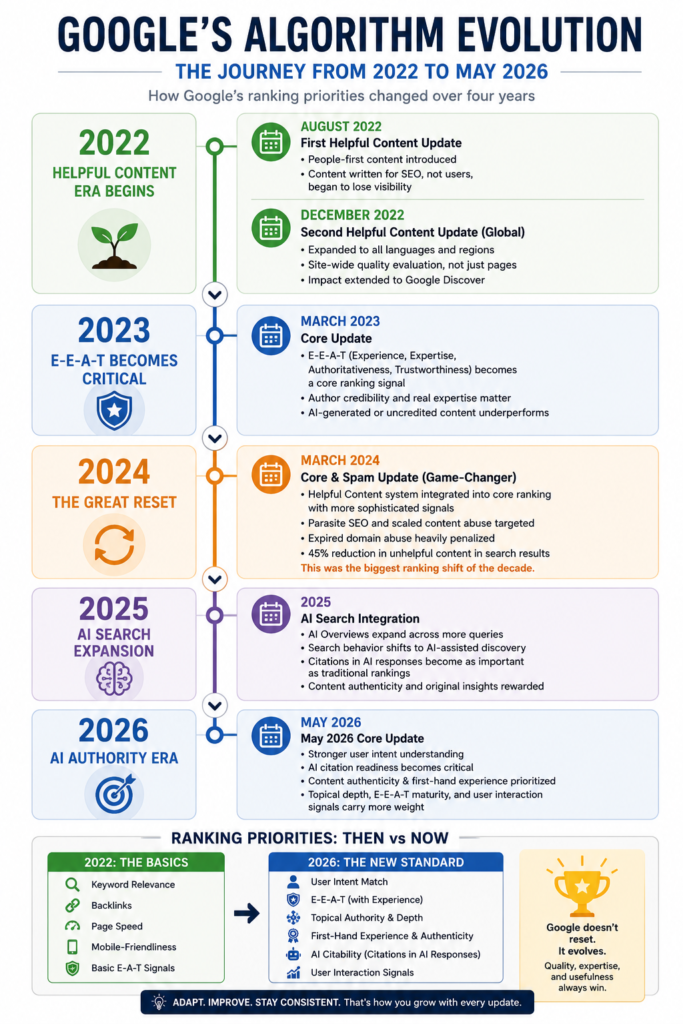
Phase 1: The “Helpful Content” Era Begins (August 2022 – December 2022)
August 2022: First Helpful Content Update
Google launched the helpful content update in August 2022 and designed it to reward content created for humans and demote SEO content. This was the first official algorithmic signal specifically targeting content quality at scale.
What Changed:
- Google introduced the concept of ‘people-first’ content
- Pages written primarily for search engines—rather than users—began seeing visibility losses
- The update affected all content types across all regions and languages
Initial Impact: Modest. Many SEOs were surprised that the impact wasn’t immediately severe.
December 2022: Second Helpful Content Update (Global)
A second Helpful Content Update started on December 5, 2022, and expanded the system to include all languages, making it a global algorithmic signal. This version took up to 40 days to roll out completely.
What Changed:
- The helpful content system became more sophisticated with new signals
- Recovery became harder; the system evaluated entire websites, not just individual pages
- Impact began affecting Google Discover in addition to Search
Phase 2: E-E-A-T Becomes Critical (March 2023 – September 2023)
March 2023: Core Update
High-quality websites with helpful content, good user experience, and strong E-E-A-T signals (Experience, Expertise, Authoritativeness, and Trustworthiness) were even more in focus.
What Changed:
- E-E-A-T became a core ranking signal, not just a guideline
- Sites needed visible author bios, credentials, and clear expertise indicators
- AI-generated or uncredited content began underperforming
Phase 3: The Seismic Shift (March 2024)
March 2024: Core & Spam Update (The Game-Changer)
One of Google’s most significant updates ever—multiple core systems were updated simultaneously. Google reported a 45% reduction in unhelpful content surfacing in search results. The rollout completed April 19, 2024 (45 days).
What Changed:
- Google formally incorporated the helpful content system into its core ranking systems with more sophisticated signals
- New spam policies targeted ‘parasite SEO’—third-party content published on trusted sites for ranking purposes
- Scaled content abuse and expired domain exploitation became heavily penalized
- Google updated its Helpful Content system to better identify content created primarily for ranking purposes
- This Was the Reset: Sites that had survived previous updates often couldn’t survive this one. The system wasn’t just looking at individual pages—it was evaluating your entire site’s purpose.
Phase 4: Refinement and AI Integration (August 2024 – December 2024)
During this phase, Google released multiple core updates with increased emphasis on original content, user experience, and content authenticity. AI content became a liability unless properly disclosed.
Phase 5: AI Search Integration (March 2025 – May 2026)
Google shifted focus to AI integration, with citations in AI responses becoming as important as ranking positions. The broader shift became even more noticeable after the March 2026 Google Core Update, where search visibility patterns started changing more aggressively across informational content. The May 2026 update continues this trend with Gemini 3.5 Flash as the default AI model.
The Core Shift: What Actually Changed Over 4 Years
If you were writing for Google in August 2022, you optimized for keywords and had a basic author byline. In May 2026, you’re writing for users who may never click your site—they might just see your content summarized in an AI Overview. Your content needs to be cited, not just ranked.
2022 Ranking Factors
- Keyword relevance
- Backlinks
- Page speed
- Mobile-friendliness
- Basic E-A-T signals
2024 Ranking Factors
- User intent match
- E-E-A-T (with Experience added)
- Original research and data
- Content created for people first
- Site-level topical authority
- Absence of spam tactics
2026 Ranking Factors
- All of the above, PLUS:
- Citability in AI responses (not just rankings)
- Content authenticity (not AI-generated or manipulated)
- Real expertise demonstration (author credentials matter)
- First-hand experience documentation
- User interaction signals
- Topical depth and comprehensiveness
The May 2026 Update Checklist: What You Need to Do Now
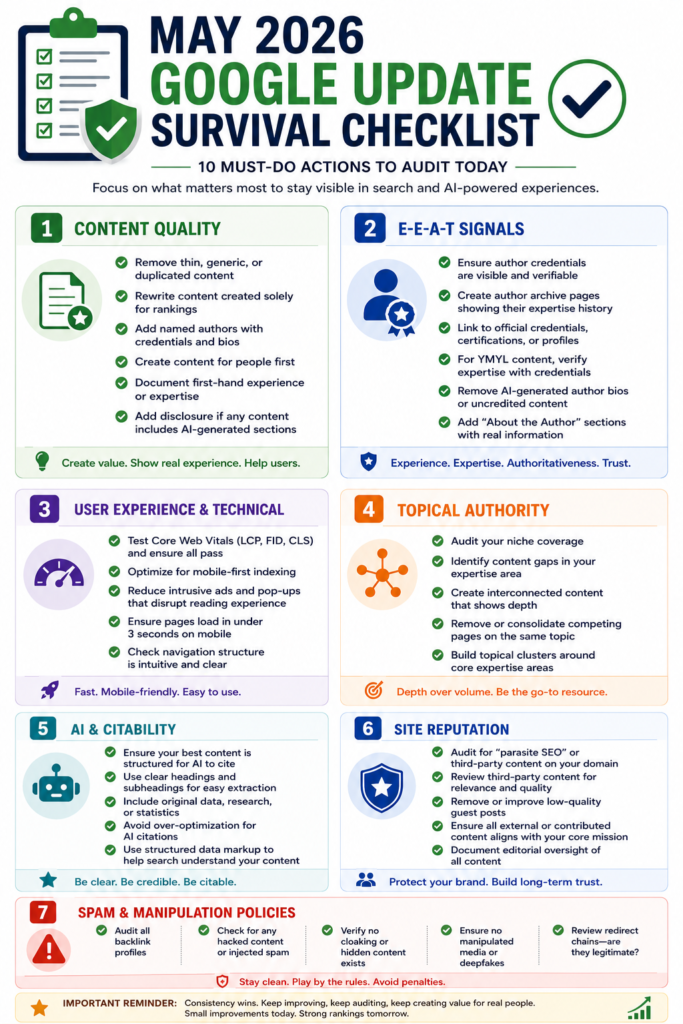
Based on the patterns of evolution and current update signals, here’s what to audit and fix:
Content Quality Audit
- Review all content created solely for ranking purposes and remove or rewrite
- Identify and remove thin, generic, or duplicated content across your site
- Add named authors with credentials and bios to every article
- Verify that content is created ‘for people first’
- Document first-hand experience or expertise in content
- Add disclosure if any content includes AI-generated sections
E-E-A-T Signals
- Ensure author credentials are visible and verifiable
- Create author archive pages showing their expertise history
- Link to official credentials, certifications, or professional profiles
- For YMYL content, verify medical/financial expertise with credentials
- Remove AI-generated author bios or uncredited content
- Add ‘About the Author’ sections with real information
User Experience & Technical
- Test Core Web Vitals (LCP, FID, CLS) and ensure all pass
- Optimize for mobile-first indexing
- Reduce intrusive ads and pop-ups that disrupt reading experience
- Ensure pages load in under 3 seconds on mobile
- Check navigation structure is intuitive and clear
Topical Authority
- Audit your niche coverage
- Identify content gaps in your expertise area
- Create interconnected content that shows depth
- Remove or consolidate competing pages on the same topic
- Build topical clusters around core expertise areas
AI & Citability
- Ensure your best content is structured for AI to cite
- Use clear headings and subheadings for easy extraction
- Include original data, research, or statistics
- Avoid over-optimization for AI citations
- Use structured data markup to help search understand your content
Site Reputation
- Audit for ‘parasite SEO’—third-party content on your domain
- Review third-party content for relevance and quality
- Remove or improve low-quality guest posts
- Ensure all external or contributed content aligns with your core mission
- Document editorial oversight of all content
Spam & Manipulation Policies
- Audit all backlink profiles
- Check for any hacked content or injected spam
- Verify no cloaking or hidden content exists
- Ensure no manipulated media or deepfakes
- Review redirect chains—are they legitimate?
Key Takeaways
1. Google doesn’t reset—it evolves. Each update builds on the previous, with stricter criteria for what counts as ‘helpful.’
2. Understanding how Google search ranking updates evolved from 2022 to 2026 can help businesses avoid outdated SEO strategies. You’re no longer just writing for search engines—you’re writing for users and competing with AI summaries.
3. Site-wide authority matters more than individual pages. Everything needs to improve.
4. Expertise and credentials are now critical. Author visibility and verification are ranking factors.
5. Authenticity is a ranking factor. AI-generated or manipulated content is actively penalized.
6. Speed and UX are table stakes. You can’t rank well if your site is slow or mobile-unfriendly.
7. Recovery takes time. Commit to 4-6 months of improvement if you’ve been hit.